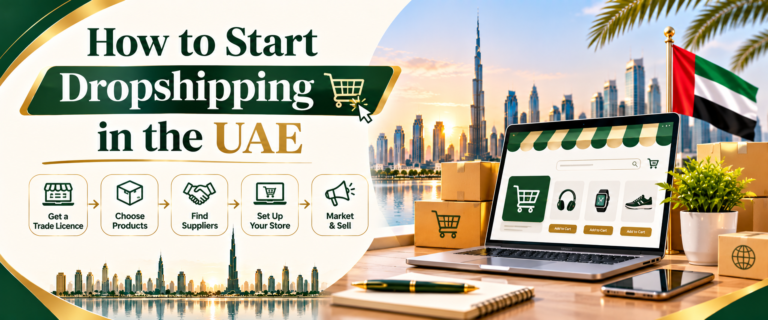
Dropshipping in UAE allows you to run an online store without buying products in bulk or keeping inventory in a warehouse. When a customer places an order, you arrange for a supplier to pack and ship the product directly to them. You manage the store, pricing, marketing, payments, and customer service.
The model can reduce the amount of money tied up in stock, but it does not remove the normal responsibilities of running a business. You still need an appropriate trade licence, trustworthy suppliers, a working payment system, and a clear plan for delivery, returns, and taxes.
This guide explains how to start a dropshipping business in the UAE in 2026, including legal requirements, licence costs, registration documents, supplier options, website setup, marketing, and the expenses that affect profitability.
Dropshipping in UAE: Quick Facts
| Question | Quick answer |
|---|---|
| Is dropshipping legal in UAE? | Yes, when the business is appropriately licensed and complies with applicable laws. |
| Is a trade licence required? | Generally, yes, for commercial online selling. |
| What type of licence is needed? | An appropriate e-commerce or trading activity licence, depending on the business model. |
| What does it cost to start? | Some advertised free zone licence packages start from AED 5,750, excluding other business expenses. |
| Is a warehouse necessary? | Usually not for a standard supplier-fulfilled model. |
| Can foreigners register a company? | Yes, subject to the chosen authority’s requirements. |
| Can you sell through Shopify or Amazon.ae? | Potentially, subject to licensing, platform rules, and payment requirements. |
| Is dropshipping tax-free? | Not automatically. VAT, corporate tax, and import obligations may apply. |
What Is Dropshipping and How Does It Work in the UAE?
Dropshipping is an e-commerce business model in which a seller advertises products and accepts orders without keeping those products in stock. Instead, a supplier stores the items and fulfils orders on the seller’s behalf.
For example, imagine you operate a Dubai-based online store selling home organisation accessories. You list a product for AED 150. A customer buys it, and you purchase that item from a supplier for AED 80. The supplier then delivers it to the customer’s address in Dubai or another supported location.
The AED 70 difference is not your final profit. Shipping, advertising, payment processing, returns, and business overheads must still be deducted.
A typical order follows five steps:
- The customer finds a product on your website and places an order.
- Your business receives the order and arranges payment.
- You send the order details to your supplier, manually or through an integration.
- The supplier packs and ships the product.
- You handle tracking questions, complaints, refunds, and other customer support.
The important distinction is that the supplier fulfils the order, but your business remains responsible for its promises to the customer.
What Are the Advantages and Challenges of Dropshipping in the UAE?
Dropshipping can be an accessible way to test online retail ideas because you do not need to purchase a full inventory before opening your store. However, the business has risks that are easy to underestimate.
| Potential advantage | Corresponding challenge |
|---|---|
| No need to purchase bulk inventory upfront | Less control over stock availability and product quality |
| Lower need for warehouse space | Dependence on suppliers and couriers |
| Ability to test different product categories | Advertising and product testing can be expensive |
| Suppliers can handle packing and dispatch | Deliveries, complaints, and refunds remain your responsibility |
| Opportunity to serve different customer markets | Cross-border tax, customs, and delivery arrangements can become complicated. |
The UAE provides access to customers who use online shopping and digital payments, along with established logistics and e-commerce services. However, established retailers and marketplaces also compete for those customers.
For a new business, dropshipping works best when you can offer a dependable purchasing experience, not simply a large catalogue of inexpensive products.
The model may be less suitable for products that are difficult to return, require special approvals, have inconsistent stock availability, or leave too little margin after delivery and advertising costs.
Is Dropshipping Legal in the UAE?
Yes. Dropshipping is legal in the UAE when it operates under an appropriate commercial licence and follows the applicable e-commerce, product, and consumer protection rules.
Federal Decree-Law No. 14 of 2023 on Modern Technology-Based Trade provides the main legal framework for technology-based trading activities in the UAE.
According to the UAE Government, businesses selling products or services online on the mainland need a commercial licence that includes the relevant e-commerce activity from the appropriate emirate’s economic licensing authority.
A free zone company may also undertake permitted e-commerce activities, although its arrangements for selling goods into the UAE mainland must be checked separately.
You cannot assume that a licence is unnecessary merely because a third-party supplier stores and ships the products.
Product restrictions also matter. Certain medicines, food products, cosmetics, medical devices, electronics, and other regulated goods may require registration, certification, or additional approvals before being sold.
Online sellers must provide accurate product information and comply with the applicable consumer protection requirements.
The UAE Government also identifies specific responsibilities involving business identification, Arabic-language information about goods and transactions, and customer invoices. These requirements should be considered when preparing an e-commerce store, rather than treating Arabic disclosures as only an optional convenience.
For the legal framework, consult the UAE Government’s e-commerce guidance and consumer protection guidance.
Which Licence Do You Need for Dropshipping in the UAE?
You generally need an e-commerce or commercial trading licence that covers the products and business activities involved in your dropshipping operation. The exact licence depends on where your company is established, where your customers are located, and how your suppliers fulfil orders.
For example, a mainland business in Dubai may apply for an approved commercial activity through the Dubai Department of Economy and Tourism. Alternatively, an eligible entrepreneur can consider a free zone offering suitable e-commerce or trading activities.
However, a free zone licence does not automatically provide unrestricted permission for every form of direct trading in the UAE mainland market. Depending on the arrangement, additional requirements may apply.
| Licensing option | Main consideration |
|---|---|
| Mainland e-commerce or commercial licence | Appropriate for approved activities under the relevant mainland authority |
| Free zone e-commerce or trading licence | Covers activities permitted by the issuing free zone, subject to any applicable mainland trading conditions |
| Dubai E-Trader licence | Has specific applicant and activity eligibility; not a universal licence for dropshipping |
There is no single licence that automatically covers all products and all sales arrangements.
Before applying, explain your business model to the authority: the products you will sell, the location of your suppliers, where goods will be shipped from, who will import them, and whether you will sell to UAE or overseas customers.
This is more reliable than selecting the lowest-priced licence without confirming whether it covers your operations.
Official guidance: Starting a Business on the Mainland and Starting a Business in a Free Zone.
How Much Does It Cost to Start Dropshipping in the UAE?
Some UAE free zone e-commerce licence packages are advertised from AED 5,750, but that is not the complete cost of starting a dropshipping business. You also need to budget for your website, products, payment services, marketing, shipping, and operating expenses.
For example, SPC Free Zone advertises an e-commerce package from AED 5,750, while Meydan Free Zone advertises a standard business licence from AED 12,500. These are provider-specific starting prices. Their inclusions, eligibility requirements, visa arrangements, and additional charges may differ.
| Expense | What affects the cost |
|---|---|
| Business licence | Jurisdiction, activity, company structure, and package inclusions |
| Domain and online store | Registrar, platform subscription, design, and extensions |
| Supplier samples | Product category, sample quantity, and delivery |
| Payment gateway | Onboarding terms, transaction fees, and settlement arrangements |
| Marketing | Advertising channels, testing period, and competition |
| Delivery and returns | Supplier location, courier, parcel size, and customer location |
| Other business costs | Accounting, possible visa services, approvals, and annual renewal |
Example starting budget: A founder choosing an eligible AED 5,750 licence package could provisionally allocate another AED 1,000 for website setup, AED 500 for samples, AED 1,500 for initial marketing, and AED 1,000 as a small operating reserve.
That creates an illustrative starting budget of AED 9,750, excluding any additional charges. It is a planning example, not a guaranteed all-inclusive price.
The cheapest licence is not necessarily the cheapest operating setup. For example, a package that does not match your actual activity can create additional costs later.
Before paying, request a written, itemised quotation showing licence activities, first-year charges, renewal fees, and any separately charged services.
What Documents Are Required to Start a Dropshipping Business in the UAE?
Individual founders generally need a valid passport copy, personal and ownership details, proposed trade names, and information about the business activities they intend to register. The complete document checklist depends on the licensing authority, legal structure, shareholder type, and applicant’s residency status.
A mainland application can require different documents from a free zone application. Requirements can also differ when a company, rather than an individual, owns the new business.
| Document or information | When it may be required |
|---|---|
| Valid passport copy | A standard identification document for individual shareholders |
| Trade name options | Used during company name reservation |
| Selected business activities | Needed to determine the permitted licence activity |
| Application and shareholder information | Required for registration and ownership checks |
| Emirates ID | May be required for UAE-resident applicants |
| Residence visa or immigration information | May be relevant to resident founders or visa applications |
| Proof of address | Requested by some authorities as part of due diligence |
| Passport photograph | Requested for certain incorporation or immigration processes |
| Business plan or activity description | Required in some applications or for particular activities |
| Corporate incorporation records | Relevant where a company is a shareholder |
| Board resolution or authorisation | May be required for corporate shareholders |
| Additional regulatory approvals | May apply to restricted or regulated products |
These are not all mandatory documents for every applicant.
For example, Meydan Free Zone’s published guidance states that a standard individual-owned formation route begins with a valid shareholder passport, chosen activities, and proposed company names.
DMCC explains that document requirements for remote company formation depend on ownership structure, activities, and where documents were issued. Corporate shareholders may need additional records and authorisations.
Do non-residents need an Emirates ID? Not necessarily. Some eligible free zone formation routes allow non-resident founders to apply without already holding a UAE residence visa or Emirates ID. A UAE resident, on the other hand, may be asked for additional identification or immigration details.
Is a No Objection Certificate required? Not in every case. An NOC may be necessary under specific authority or applicant circumstances, but it should not be described as a universal requirement for dropshipping.
Where an existing foreign company will own the new entity, its registration documents and authorising resolutions may need certification, legalisation, or translation.
Keep company formation documents separate from bank account documents. A bank may request further records after the company has been incorporated, such as source-of-funds information, expected business activity, and supplier details.
Request the latest checklist from your chosen licensing authority before applying.
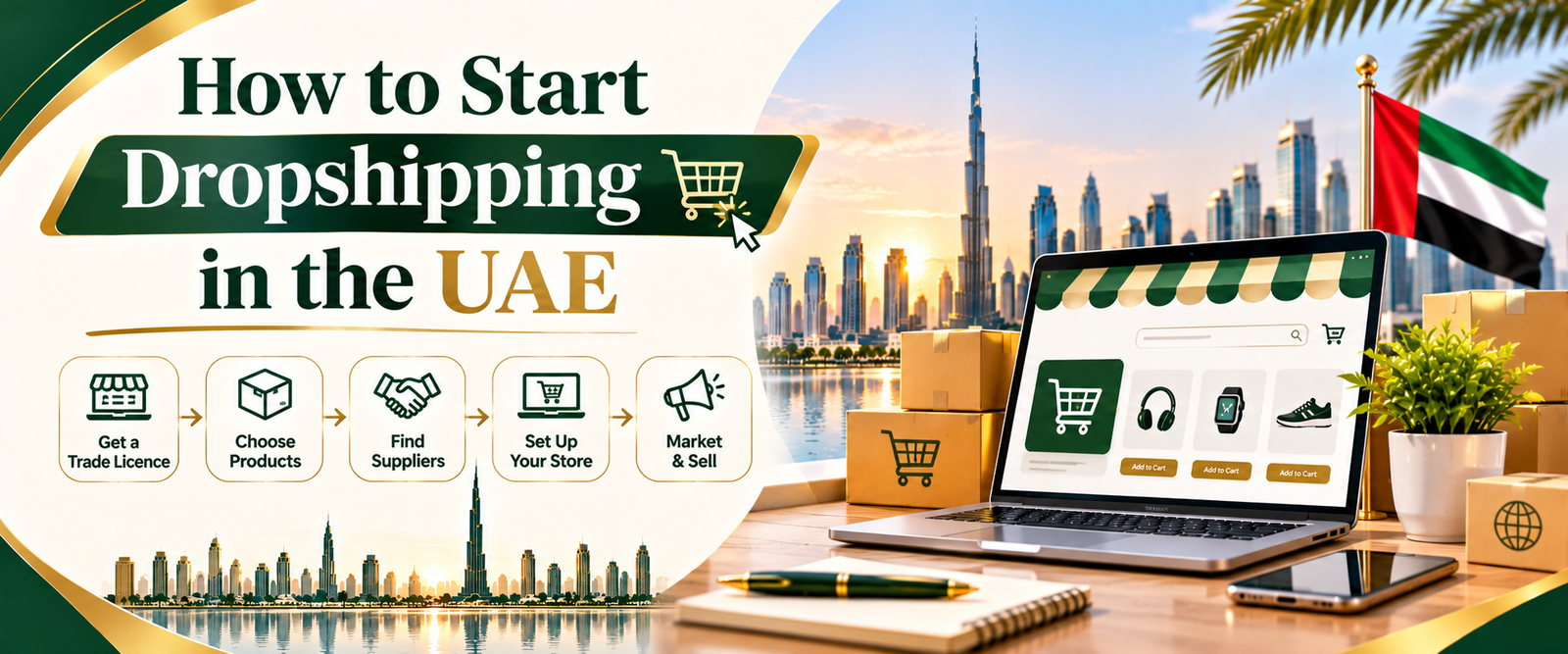
How to Start a Dropshipping Business in the UAE: Step-by-Step
Starting a dropshipping business in UAE involves choosing products, registering the appropriate business activity, establishing supplier relationships, and testing the full customer order process.
Step 1: Choose a product niche. Begin with a specific category and target audience. Ordinary home accessories, desk organisers, and storage products are examples of categories you could research, rather than verified best-selling niches. Check demand, pricing, return risk, shipping requirements, and regulatory restrictions before selecting products.
Step 2: Research customers and competitors. Study relevant Google searches, product listings, online marketplaces, and customer reviews. Compare selling prices and delivery promises. Look for complaints about poor quality or difficult refunds, as these may reveal service problems you could avoid.
Step 3: Select the appropriate licence. Choose a mainland or free zone structure based on your intended activities and sales arrangements. Confirm that the authority permits your product category and fulfilment model.
Step 4: Register your company. Prepare the documents described earlier, submit the application, complete any required checks, and obtain the approved trade licence before commencing regulated commercial operations.
Step 5: Find and test suppliers. Check stock availability, product specifications, sample quality, shipping costs, delivery times, and refund procedures. Agree on responsibilities in writing.
Step 6: Build the online store. Choose a suitable platform, create accurate product pages, and add business identification, shipping, contact, and refund information. Test the mobile experience.
Step 7: Arrange payments. Check the bank and payment gateway’s requirements. Confirm supported countries, transaction fees, settlement times, and refund handling before going live.
Step 8: Agree on fulfilment and shipping. Determine who dispatches each order, who provides tracking, who is responsible for customs, and how lost or returned parcels are handled.
Step 9: Test a complete order. Check product availability, checkout, payment confirmation, supplier notification, delivery tracking, and customer communications. Resolve problems before spending heavily on advertising.
Step 10: Launch and measure results. Begin with a limited product range and controlled marketing budget. Track the actual cost of acquiring customers, delivering orders, and processing refunds.
The goal is not to open the largest possible catalogue. It is to confirm that customers can order, receive the correct products, and get help when something goes wrong.
How to Find Reliable Dropshipping Suppliers in the UAE
Finding reliable dropshipping suppliers in the UAE is important because supplier performance affects delivery times, product quality, and the number of refunds your business may face.
There are three broad options: UAE-based wholesalers that agree to fulfil individual customer orders, international sourcing platforms, and specialised fulfilment providers.
Not every wholesaler offers dropshipping, and not every fulfilment provider sells products.
The following platforms are worth researching, but they should not be treated as verified UAE-local suppliers or guaranteed shipping partners.
| Platform | What it does | What UAE sellers should check |
|---|---|---|
| AliExpress | Marketplace where individual merchants sell products; some support dropshipping arrangements | Supplier reliability, UAE delivery availability, tracking, delivery time, and returns |
| CJdropshipping | Product sourcing and order fulfilment service with store integration options | Availability for the specific product, shipping method, destination, and total delivered cost |
| DSers | Order management and automation tool commonly used with AliExpress and supported stores. | Supplier availability, integration compatibility, order processing, and tracking |
| UAE-based wholesalers | Local product suppliers, some of which may agree to ship individual orders | Whether dropshipping is offered, actual inventory, dispatch terms, and return handling |
AliExpress can provide access to a wide range of product sellers, but each seller’s reliability and delivery options may differ.
CJdropshipping offers sourcing and fulfilment workflows, including connections to online stores. You should obtain a product-specific shipping quote rather than assuming every item can reach the UAE within the same period.
DSers is primarily an integration and order management service, not a single warehouse supplying every product. It can help manage orders placed with connected suppliers.
For UAE-based wholesalers, ask whether they support single-order dispatch, provide unbranded or agreed packaging, and share tracking details.
Before choosing any supplier, place a sample order where practical. Check the product against the listing, measure the real delivery time, and calculate what a return would cost.
Ask these questions before signing an agreement:
- Is the product currently available?
- Where will the parcel be shipped from?
- What is the full shipping charge to the intended customer location?
- Who handles damaged, missing, or incorrect orders?
- How quickly are returns or refunds processed?
- Can order and inventory updates connect to your store?
- Who is responsible for any import or customs requirements?
A supplier offering a low purchase price may still be expensive if shipping is slow or customers frequently return products.
Platform references: AliExpress, CJdropshipping, and DSers.
Which Products Are Suitable for Dropshipping in the UAE?
A suitable product for dropshipping should have demand, reliable sourcing, manageable delivery costs, and sufficient selling margin.
There is no evidence that one product category guarantees profits across the entire UAE market.
For beginners, relatively lightweight and easy-to-describe products may be simpler to evaluate than fragile or highly regulated goods. Everyday storage accessories, desk organisers, and selected home products are possible starting points for research.
When deciding whether to sell an item, consider the following:
- Selling price: Can customers find the same item much cheaper elsewhere?
- Product cost: How much will the supplier charge per order?
- Delivery: Can the item reach your target customers within a realistic time?
- Returns: What happens if the customer receives a damaged or incorrect item?
- Competition: What makes your offering useful or different?
- Regulations: Does the product need approval, registration, or conformity documentation?
Avoid assuming that a category is suitable just because it appears in a dropshipping catalogue.
Food, medicines, certain cosmetics, medical devices, and other regulated products require particular care. Relevant approvals may be needed before offering them for sale.
A narrow product range with reliable fulfilment is often easier to test than hundreds of listings with uncertain stock.
How to Build a Dropshipping Website for UAE Customers
A dropshipping website should make buying simple and clearly explain who is selling the product, what it costs, when it will arrive, and what happens if a customer wants a refund.
Platforms such as Shopify and WooCommerce can support independent online stores, while marketplaces such as Amazon.ae have their own seller systems and requirements.
| Selling channel | Main benefit | Main limitation |
|---|---|---|
| Shopify or WooCommerce website | More control over branding, customer experience, and product presentation | You must attract visitors and manage the store’s operations |
| Amazon.ae marketplace | Access to an established shopping marketplace | Seller verification, fees, listing rules, and fulfilment policies apply |
| Other marketplaces | May provide access to additional shoppers | Platform-specific onboarding and selling requirements |
Marketplace selling is not the same as operating an independent dropshipping store. In particular, do not assume that a marketplace accepts every supplier-direct shipping arrangement. Review the marketplace’s seller-of-record, packaging, returns, and fulfilment policies before listing products.
Amazon’s official UAE seller guidance confirms that UAE-based businesses must satisfy commercial licensing requirements. Separate seller verification and category rules may also apply.
For your own website, use clear product names, accurate images, AED prices for UAE customers, shipping information, and accessible contact details.
Provide required licensing and transaction disclosures. UAE consumer protection guidance also identifies Arabic-language information requirements for e-commerce businesses, including relevant product and contract information.
Digital traders must provide customers with clear digital invoices under the applicable framework. An order confirmation alone should not be assumed to meet every invoice requirement.
Before launch, test your website on mobile and desktop devices, including product selection, checkout, payment, tracking information, and customer support.
How to Accept Payments and Manage Deliveries in UAE Dropshipping
A dropshipping business needs a way to receive customer payments and a reliable process for sending orders to suppliers.
Depending on the provider and your business eligibility, you may be able to accept card payments, supported digital payment methods, or cash on delivery.
Payment providers can request the trade licence, company ownership details, bank account information, website policies, and information about products sold.
Having a trade licence does not guarantee acceptance by a bank or merchant payment provider.
Cash on delivery (COD) may be offered through certain courier and fulfilment arrangements. It can be convenient for some customers, but it creates risks when deliveries are rejected, customers cannot be contacted, or cash is settled after a delay.
Before offering COD, verify collection fees, settlement timing, failed-delivery costs, and responsibility for returned parcels.
Delivery planning is equally important.
If goods are held inside the UAE, local dispatch may be possible depending on the supplier and courier. If products come from overseas, customs clearance, import charges, and longer delivery times may affect the customer experience.
Your store should explain delivery estimates honestly and disclose relevant charges.
Keep a clear record of customer orders, supplier payments, shipping confirmations, invoices, and refunds.
How to Market Your Dropshipping Business in the UAE
Once the store is ready, the next challenge is attracting the right customers without spending more on advertising than each sale can support.
Start with a small number of products and a clear target audience. For example, a store selling desk organisation products could focus its messaging on people looking for practical home-office accessories rather than advertising hundreds of unrelated items.
Search engine optimisation (SEO) can help your product and category pages appear for relevant searches. Write original product descriptions, answer practical customer questions, use descriptive page titles, and keep your website fast and mobile-friendly. Organic search normally requires time and consistent work.
Google Ads can reach people already searching for particular products. Begin with a controlled test budget, track conversions, and check the cost of each completed order. Do not judge a campaign only by clicks.
Instagram, TikTok, and other social channels can help demonstrate products through useful images and videos. Show what the product actually does, its size, how it is used, and realistic delivery information.
If you work with creators or influencers, check the applicable advertising and commercial promotion requirements. Clearly disclose paid commercial relationships where required.
Customer acquisition cost matters more than traffic alone. If a sale leaves AED 45 after product, delivery, and payment fees but costs AED 60 in advertising, that sale is losing money before other expenses.
A practical early marketing plan is to test a limited number of products, monitor which campaigns produce completed purchases, pause consistently unprofitable ads, and improve the offer before increasing spending.
You can also encourage repeat purchases through reliable service, accurate product information, and appropriate customer communications.
Avoid purchasing fake reviews, making unsupported claims, or promising delivery dates your supplier cannot meet.
VAT, Corporate Tax and Customs Rules for UAE Dropshipping
Dropshipping businesses may have VAT, corporate tax, and customs obligations. The applicable treatment depends on the legal structure, location of goods, customer, supplier, and transaction details.
VAT: For UAE-resident businesses, VAT registration is generally mandatory when taxable supplies and imports exceed AED 375,000 over the previous 12 months or are expected to exceed that threshold within the next 30 days.
Voluntary registration may be available when the relevant supplies, imports, or qualifying expenses meet the AED 187,500 threshold.
Non-resident businesses making taxable supplies in the UAE can face different registration rules. In certain circumstances, registration applies without the normal resident-business turnover threshold.
A free zone licence does not automatically exempt a business from VAT. Cross-border sales and movements of goods require examination of the actual supply and import arrangements.
Corporate tax: Under the standard UAE corporate tax rules, taxable income up to AED 375,000 is generally taxed at 0%, while taxable income above that amount is generally subject to 9%.
This threshold refers to taxable income, not sales turnover.
Qualifying Free Zone Persons are subject to a separate regime. Qualifying income may benefit from a 0% rate, while taxable income that does not qualify is generally taxed at 9%. A free zone company should not assume all dropshipping income qualifies for the zero rate.
Natural persons conducting business in their own names have separate rules. The Federal Tax Authority explains that the business turnover threshold for a natural person to come within the corporate tax regime is AED 1 million in a calendar year, subject to the applicable conditions.
Customs: When goods enter the UAE, the responsible party may need to handle customs declarations, import charges, VAT, and product-specific requirements.
In a dropshipping arrangement, the seller, supplier, and customer may be located in different countries. Identify who is the importer and who is responsible for import costs before accepting orders.
Because tax outcomes depend on the actual business structure and supply chain, professional advice may be needed for international or complex arrangements.
Official sources: Federal Tax Authority — VAT Registration, Corporate Tax Rates, and Corporate Tax for Natural Persons.
Is Dropshipping Profitable in the UAE?
Dropshipping can be profitable if customers are willing to pay enough to cover the product, shipping, payment processing, advertising, refunds, and ongoing business expenses.
However, there is no guaranteed profit margin. The number of orders is not enough to measure success.
Consider this hypothetical example of a single order:
| Item | Amount |
|---|---|
| Product selling price | AED 150 |
| Supplier charge | − AED 75 |
| Shipping and fulfilment | − AED 20 |
| Payment processing | − AED 5 |
| Advertising attributed to the sale | − AED 25 |
| Allowance for refunds and losses | − AED 5 |
| Contribution before fixed costs and applicable taxes | AED 20 |
The remaining AED 20 represents approximately 13.3% of the selling price before fixed expenses and applicable taxes.
This is an illustration, not an average UAE dropshipping margin. The final accounting may also differ depending on VAT registration and how amounts are treated.
Now consider the impact of a higher advertising cost. If advertising rises from AED 25 to AED 45 per sale, the AED 20 contribution disappears.
That is why a product with an attractive supplier price can still be unprofitable.
You must also recover annual licence costs, website subscriptions, software expenses, accounting fees, and other overheads.
A practical formula is:
Selling revenue − product cost − fulfilment − payment charges − advertising − expected returns = contribution before fixed overheads and taxes.
Track this figure alongside actual cash flow. A business may have profitable orders but still face cash shortages if suppliers require immediate payment and customer payments settle later.
Can You Start Dropshipping in the UAE Without Residency?
Yes, eligible foreign entrepreneurs may be able to register a UAE company without already holding a UAE residence visa. Some licensing authorities provide remote incorporation options, subject to the ownership structure and application requirements.
However, company formation, residency, and banking are different processes.
Being permitted to register a business does not automatically grant you a UAE residence visa or guarantee approval for a corporate bank account.
Banks may request additional identification, proof of address, company records, business plans, or information about customers and suppliers.
Before registering remotely, confirm whether the chosen authority accepts non-resident applicants, whether any visit is required, and whether your intended banking and payment arrangements are realistic.
You should also consider tax obligations in the country from which you manage the business.
Common Mistakes to Avoid When Starting Dropshipping in UAE
Many new sellers concentrate on finding inexpensive products and launching a website, but overlook the expenses and obligations that determine whether the business can operate successfully.
A common mistake is choosing a licence without confirming that it covers the intended sales activity. Another is copying a supplier’s catalogue without checking product quality, stock, delivery time, or legal restrictions.
Sellers can also lose money by spending heavily on advertising before testing order fulfilment.
Before launching, check that you have:
-
Selected the correct licensed activity for your products and sales arrangements.
-
Prepared the documents required by your authority.
-
Confirmed product approvals or restrictions.
-
Tested supplier quality and delivery performance.
-
Checked the payment gateway and banking requirements.
-
Published accurate product information, customer terms, and required disclosures.
-
Arranged digital invoices, customer support, delivery, and returns.
-
Calculated costs after shipping, marketing, payment fees, and refunds.
-
Reviewed applicable VAT, corporate tax, and customs requirements.
-
Tested a complete customer order before scaling.
A smaller store with reliable operations is a better starting point than a large store that cannot fulfil its promises.
Frequently Asked Questions About Dropshipping in UAE
Can I start dropshipping in UAE without buying inventory?
Yes. Under the standard dropshipping model, the supplier stores and ships products. You still need to pay for licensing, website operations, marketing, and other business expenses.
Can foreigners start a dropshipping business in Dubai?
Yes. Eligible foreign entrepreneurs can establish businesses in Dubai, subject to the chosen licensing authority and applicable legal requirements.
Do I need an Emirates ID to start dropshipping in the UAE?
Not always. Some company formation routes are available to eligible non-residents without an existing Emirates ID. Requirements differ between licensing authorities.
Is a No Objection Certificate mandatory?
Not universally. An NOC may be required in certain situations, but it is not a standard requirement for every applicant.
Do I need a warehouse for dropshipping?
Usually not if the supplier stores and dispatches products. Your company may still need an approved registered business address.
Can I use Shopify for dropshipping in UAE?
Yes, provided your business is appropriately licensed and meets the platform and payment provider requirements.
Can I sell dropshipping products on Amazon.ae?
Potentially, but you must meet Amazon’s licensing, seller verification, listing, and fulfilment policies. Not every supplier-direct arrangement is suitable for marketplace selling.
Can I use international suppliers for UAE customers?
Potentially, yes. Check delivery availability, import arrangements, customs responsibilities, product compliance, and refund processes before accepting orders.
Can I offer cash on delivery?
Some courier and fulfilment providers support COD. Confirm their fees, settlement periods, return arrangements, and failed-delivery charges.
Can I manage a UAE dropshipping company from abroad?
It may be possible depending on incorporation, banking, payment, and operating requirements. Tax obligations in your country of residence may also apply.