
Safe societies are built upon trust, fairness, accountability, and effective institutions. Public safety, reliable emergency services, efficient judicial systems, and confidence in public institutions all contribute to environments where individuals, families, communities, and businesses can thrive.
A strong framework for safety and justice extends beyond crime prevention and law enforcement. It includes protecting rights, maintaining public order, ensuring equal access to justice, supporting emergency preparedness, and creating conditions that promote confidence in social and economic systems. Together, these elements help establish stable and resilient societies capable of supporting long-term development.
Security and justice are closely interconnected. Public confidence grows when individuals feel protected, institutions operate transparently, and legal systems resolve disputes fairly and efficiently. Trust in these systems encourages participation in society, supports investment, strengthens economic activity, and contributes to overall quality of life.
As societies become increasingly complex and interconnected, maintaining safety requires ongoing collaboration between public institutions, emergency services, judicial systems, businesses, and communities. Effective coordination helps address emerging challenges while supporting resilience, stability, and public wellbeing.
The development of safe and fair systems remains an essential component of sustainable progress. Communities that successfully balance security, justice, transparency, and public trust are often better positioned to achieve long-term prosperity and social cohesion.
Safety is one of the most fundamental requirements for societal wellbeing. Individuals are more likely to pursue education, employment, entrepreneurship, and community participation when they feel secure in their daily lives. Public safety helps create environments where people can focus on personal growth and contribute positively to society.
Justice systems play an equally important role by ensuring fairness, accountability, and protection under the law. Efficient judicial processes help resolve disputes, protect rights, enforce contracts, and maintain confidence in public institutions. Fair and accessible legal systems contribute to social stability by providing clear mechanisms for addressing challenges and conflicts.
Businesses also rely heavily on safe environments and predictable legal frameworks. Investors, entrepreneurs, and organizations are more likely to operate and expand in jurisdictions where security risks are minimized and legal systems function effectively. Stable institutions reduce uncertainty and support long-term economic development.
Public trust serves as the foundation that connects safety and justice. Confidence in police services, emergency responders, courts, and public authorities encourages cooperation between citizens and institutions. This cooperation strengthens community resilience and improves collective outcomes.
Ultimately, safe and fair societies create conditions that support wellbeing, opportunity, prosperity, and social stability. By maintaining trust, security, and justice, communities can build stronger foundations for future development.

Creating safe communities requires a comprehensive approach that combines prevention, preparedness, responsiveness, and public engagement. Effective safety strategies address both immediate risks and long-term factors that influence security and wellbeing.
Public safety initiatives help protect individuals, families, and communities from harm. These efforts include crime prevention programs, community engagement initiatives, public awareness campaigns, and coordinated safety planning. Preventive approaches often help reduce risks before incidents occur while strengthening trust between institutions and citizens.
Preparedness plays a critical role in protecting communities during unexpected events. Emergency response systems, disaster planning, communication networks, and coordinated response protocols help ensure that assistance can be delivered efficiently when needed. Prepared communities are often more resilient and better able to recover from disruptions.
Trust encourages cooperation between residents and public institutions. When communities have confidence in safety services, individuals are more likely to report concerns, participate in community programs, and contribute to collective security efforts. Strong relationships between institutions and citizens help create safer environments for everyone.
Reliable public institutions support stability by delivering consistent services, enforcing regulations fairly, and maintaining accountability. Transparency and professionalism help strengthen confidence while improving institutional effectiveness.
Transportation safety remains an important component of public wellbeing. Infrastructure design, driver awareness, enforcement measures, and safety technologies all contribute to reducing accidents and improving mobility. Safer transportation systems protect lives while supporting economic activity and connectivity.
Modern safety strategies increasingly focus on identifying potential risks before they become major challenges. Data analysis, monitoring systems, preparedness planning, and interagency coordination help organizations respond effectively to evolving threats while minimizing disruptions.
Judicial systems serve as guardians of fairness, accountability, and legal certainty. Their effectiveness influences public trust, economic confidence, and social stability across all areas of society.
The rule of law ensures that laws are applied consistently and fairly. It provides clear frameworks for protecting rights, resolving disputes, and maintaining accountability. Strong legal systems help create environments where individuals and organizations can operate with confidence.
Accessible justice allows individuals and organizations to seek fair resolution when disputes arise. Efficient access to legal processes helps strengthen confidence in institutions while supporting equal treatment under the law.
Efficiency is an important measure of judicial performance. Timely case resolution, streamlined procedures, and effective court administration help reduce uncertainty while improving public satisfaction and institutional effectiveness.
Businesses rely on legal certainty when making investments, entering contracts, and planning long-term activities. Fair judicial systems help protect commercial relationships while supporting economic growth and entrepreneurship.
Effective dispute resolution mechanisms help individuals and organizations address disagreements in constructive ways. Courts, mediation services, arbitration systems, and other legal processes contribute to stability and fairness.
Transparent judicial processes help build public confidence by demonstrating fairness and impartiality. Accountability mechanisms strengthen institutional integrity and support trust in legal outcomes.
Trust in judicial systems contributes directly to broader societal confidence. When citizens believe institutions operate fairly and effectively, social cohesion and stability are strengthened.
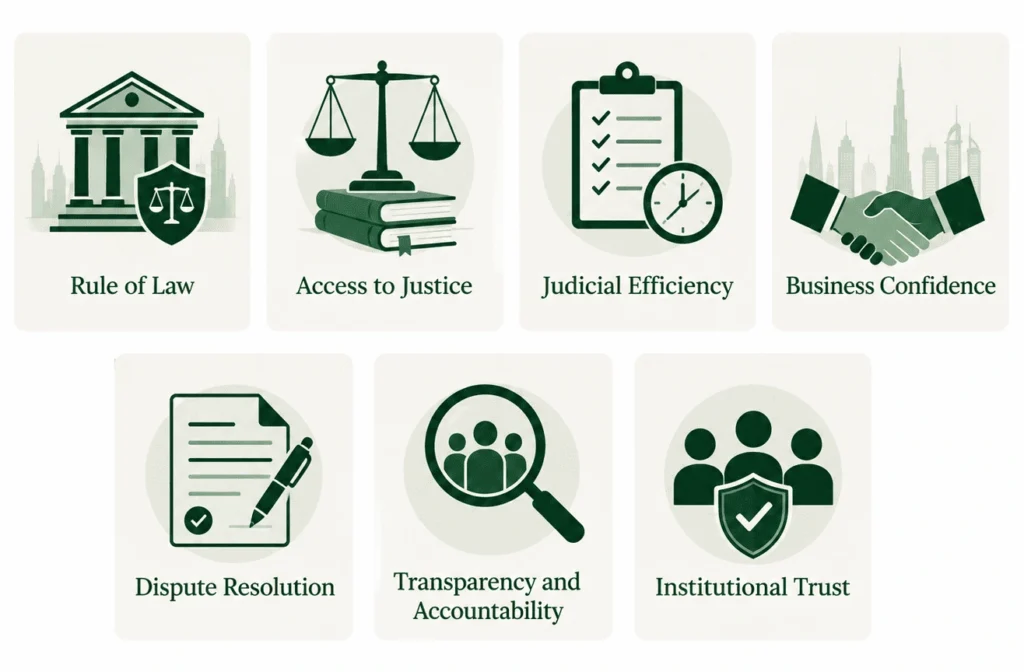

The effectiveness of safety and justice systems can be evaluated through a range of indicators that reflect public confidence, institutional performance, and societal outcomes.
| Area | Contribution |
|---|---|
| Sense of Security | Reflects public confidence and personal safety |
| Police Reliability | Measures trust in security and law enforcement services |
| Emergency Response | Evaluates preparedness and responsiveness |
| Judicial Efficiency | Assesses effectiveness and speed of legal processes |
| Road Safety | Measures transportation safety outcomes |
| Public Trust | Strengthens confidence in institutions |
| Rule of Law | Supports fairness and accountability |
| Community Safety | Promotes stable and secure environments |
| Crisis Preparedness | Enhances resilience and emergency readiness |
| Legal Accessibility | Supports equal access to justice |
These indicators provide valuable insights into how effectively societies maintain safety, trust, and justice while supporting long-term development goals.
Modern societies require robust emergency management systems capable of responding quickly and effectively to a wide range of situations. Emergency readiness supports public safety while helping communities remain resilient during periods of disruption.
Emergency response systems include medical services, fire services, law enforcement, disaster management agencies, communication networks, and specialized response teams. Coordination among these organizations helps ensure that resources can be deployed efficiently when required.
Preparedness begins long before emergencies occur. Planning, training exercises, risk assessments, public awareness campaigns, and technology investments all contribute to stronger response capabilities. These efforts help reduce vulnerabilities while improving operational effectiveness.
Public education also plays an important role in emergency readiness. Individuals who understand safety procedures, emergency communication systems, and preparedness strategies are often better equipped to respond appropriately during unexpected events.
Technological innovation continues to enhance emergency management capabilities. Advanced communication systems, geographic information technologies, predictive analytics, and real-time monitoring tools help organizations improve decision-making while increasing response speed and accuracy.
Strong emergency readiness contributes to public confidence by demonstrating that communities have the resources and capabilities necessary to protect lives, property, and essential services.
Safety and economic development are closely connected. Stable environments attract investment, encourage entrepreneurship, and support long-term business growth. Investors and organizations often evaluate security, institutional effectiveness, and legal certainty when making strategic decisions.
Reliable judicial systems help create predictable business environments by protecting contracts, intellectual property, and commercial relationships. Effective dispute resolution reduces uncertainty while supporting economic activity and innovation.
Public safety also contributes to workforce development and talent attraction. Individuals are more likely to live, work, study, and invest in communities where they feel secure and supported by effective institutions.
Strong institutions can improve national competitiveness by enhancing confidence among businesses, investors, and international partners. Trustworthy governance systems often contribute to higher levels of investment, economic diversification, and sustainable growth.
By supporting security, fairness, and stability, public institutions help create conditions that enable economic opportunity and long-term prosperity.

Advances in technology are reshaping how societies approach safety, security, and justice. Emerging innovations are helping institutions improve efficiency, responsiveness, and accessibility.
Artificial intelligence is increasingly being used to support data analysis, risk assessment, operational planning, and administrative processes. These technologies can help organizations allocate resources more effectively while improving decision-making.
Digital court systems and online legal services are expanding access to justice by streamlining procedures and reducing administrative burdens. Technology-enabled solutions can improve efficiency while enhancing user experiences.
Smart city infrastructure is contributing to public safety through integrated monitoring systems, intelligent transportation networks, emergency communication platforms, and real-time data analytics. These tools help improve situational awareness and operational coordination.
Cybersecurity has become an essential component of modern safety strategies. As societies become increasingly digital, protecting information systems and critical infrastructure remains a growing priority.
Predictive analytics, advanced communications, automation, and connected technologies are expected to continue shaping the future of public safety and justice. Institutions that successfully adapt to these developments will be better positioned to address emerging challenges while maintaining public trust.
Safe and fair societies are built upon trust, accountability, preparedness, and effective institutions. Public safety, reliable emergency services, efficient judicial systems, and transparent governance all contribute to environments where individuals and communities can prosper.
Security and justice are not isolated objectives. Together, they support social stability, economic confidence, community wellbeing, and long-term resilience. By strengthening institutions, improving preparedness, promoting fairness, and maintaining public trust, societies create foundations that support sustainable development and future success.
As communities continue to evolve, ongoing investment in safety, justice, innovation, and institutional effectiveness will remain essential for protecting quality of life while supporting progress across every aspect of society.