
Long-term national development requires more than vision, ambition, and investment. It requires the ability to understand whether progress is being achieved, where challenges remain, and how future decisions can create better outcomes for society. National Key Performance Indicators (KPIs) provide a framework for measuring progress across the UAE’s most important development priorities.
Every successful nation relies on reliable data to guide decisions and evaluate results. While strategies establish direction, performance indicators help determine whether those strategies are producing meaningful improvements. They transform broad goals into measurable outcomes that can be monitored, analyzed, and improved over time.
Across areas such as social wellbeing, public safety, education, healthcare, economic competitiveness, sustainability, and infrastructure, performance indicators provide valuable insights into how effectively a country is progressing toward its long-term objectives. They help governments, institutions, businesses, and communities understand where strengths exist, where improvements are needed, and where future opportunities may emerge.
National Key Performance Indicators are not simply statistics. They represent the measurable outcomes of policies, investments, innovation, and collaboration across society. By tracking performance consistently, decision-makers can identify trends, evaluate effectiveness, and create strategies that support sustainable growth and prosperity for future generations.
Development is often discussed in terms of major projects, economic growth, technological advancement, or social initiatives. While these efforts are important, true progress can only be understood when outcomes are measured consistently over time.
A growing economy, for example, may indicate increased productivity and investment, but economic performance alone does not reveal whether people are healthier, better educated, safer, or more satisfied with their quality of life. Likewise, strong infrastructure projects may improve transportation and connectivity, but their long-term impact must be evaluated through measurable improvements in efficiency, accessibility, and economic activity.
Performance indicators help connect actions with outcomes. They provide evidence that allows leaders to evaluate whether investments are producing meaningful results and whether resources are being allocated effectively. They also help identify emerging challenges before they become larger issues, enabling more proactive and informed decision-making.
Modern societies are increasingly interconnected. Educational achievement influences workforce quality. Workforce quality affects economic competitiveness. Economic growth supports healthcare, infrastructure, and public services. Social cohesion contributes to stability, resilience, and community wellbeing. Because these systems influence one another, measuring performance across multiple areas provides a more complete understanding of national progress.
The ability to measure outcomes accurately has become one of the most important foundations of successful governance and long-term planning. Nations that understand their performance are better positioned to adapt to change, improve public services, attract investment, and create opportunities for future growth.
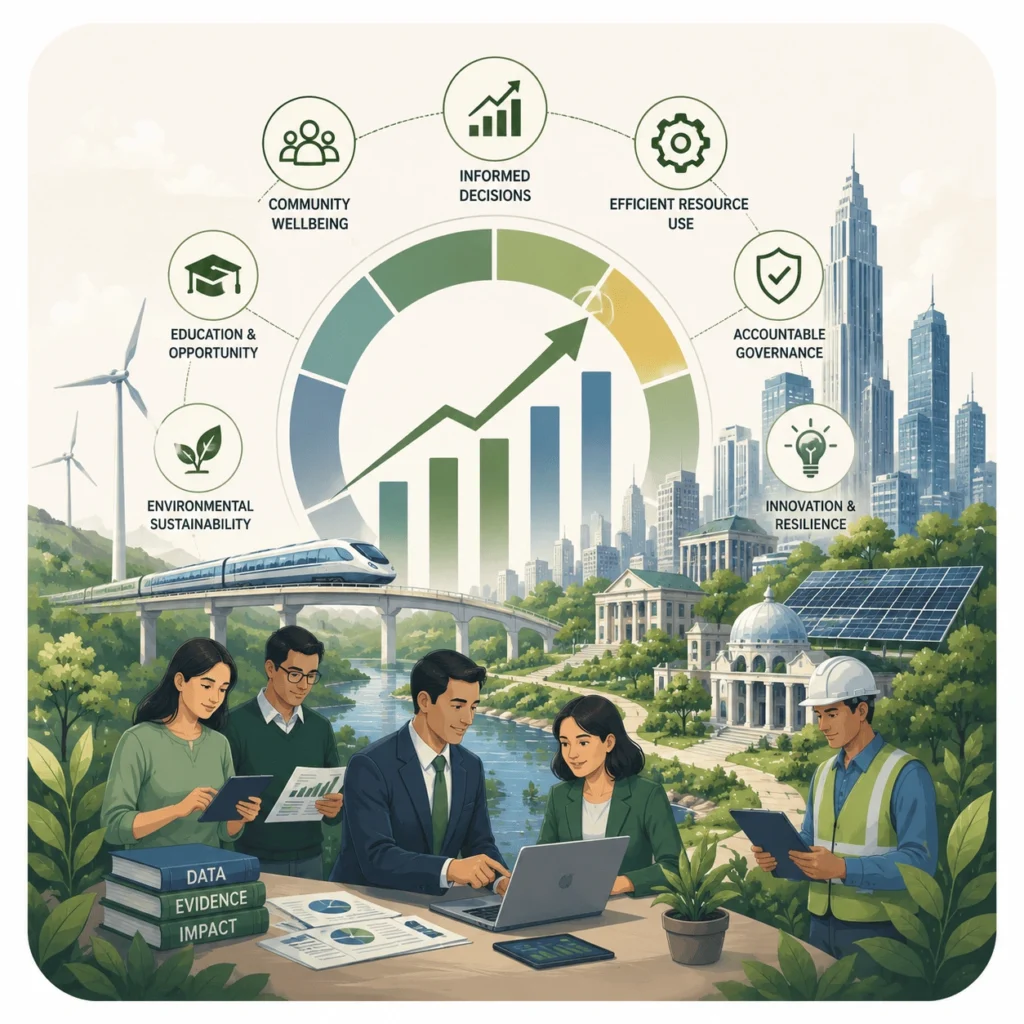
National development is rarely driven by a single initiative or sector. Instead, progress emerges from the combined performance of multiple systems working together to support economic prosperity, social wellbeing, and long-term sustainability.
Performance frameworks provide a structured method for evaluating how these systems are functioning. Rather than focusing solely on activities or projects, indicators measure outcomes that directly affect people, businesses, and communities.
For example, educational indicators may assess student achievement, graduation rates, and learning quality. Healthcare indicators may measure population wellbeing, access to care, and preventive health outcomes. Economic indicators evaluate productivity, innovation, investment, and workforce participation. Infrastructure indicators assess transportation efficiency, connectivity, and service quality.
When viewed collectively, these measurements create a comprehensive picture of national performance. They help identify relationships between different sectors and reveal how progress in one area may contribute to improvements in another.
A strong performance framework supports transparency, accountability, and evidence-based planning. It helps ensure that development efforts remain focused on meaningful outcomes rather than short-term activity alone.
Strong societies are built upon shared values, cultural identity, social cohesion, and a sense of belonging. Community wellbeing extends beyond economic indicators and includes the relationships, institutions, traditions, and social structures that help people thrive. Indicators within this area help evaluate social participation, family stability, cultural preservation, community engagement, and overall quality of life. They provide insights into how effectively societies maintain social cohesion while adapting to changing economic and demographic conditions. A cohesive society creates stronger communities, greater resilience, and a more stable environment for future development.
Security, trust, and fairness are fundamental requirements for sustainable growth. Individuals, businesses, and communities perform best when they operate within environments supported by effective institutions and reliable legal systems. Performance indicators within this area help evaluate public safety, judicial effectiveness, emergency preparedness, law enforcement performance, and institutional trust. These measures help determine how effectively societies protect rights, maintain stability, and respond to challenges. Strong institutions create confidence, encourage investment, and support long-term social and economic development.
In modern economies, knowledge, innovation, entrepreneurship, and talent have become essential drivers of growth. Competitive economies are increasingly defined by their ability to generate ideas, develop skilled workforces, attract investment, and adapt to changing technologies. Indicators within this area evaluate productivity, competitiveness, innovation, entrepreneurship, workforce development, research activity, and investment performance. These measurements help assess the ability of economies to create value and remain competitive within global markets. A strong knowledge economy supports sustainable growth while creating opportunities for future generations.
Education plays a critical role in shaping individuals, communities, and economies. High-quality education helps develop knowledge, skills, creativity, and critical thinking while preparing future generations to contribute meaningfully to society. Performance indicators within this area evaluate educational quality, student achievement, graduation outcomes, leadership effectiveness, and access to learning opportunities. They help assess whether educational systems are preparing students for future economic and social challenges. Strong education systems contribute to innovation, productivity, social mobility, and long-term prosperity.
Healthy populations are essential for sustainable development. Healthcare influences quality of life, workforce productivity, community wellbeing, and economic resilience. Indicators within this area help measure healthcare quality, access to services, prevention efforts, workforce capacity, medical innovation, and population health outcomes. These measurements provide insights into how effectively healthcare systems support both individual wellbeing and broader societal development. Strong healthcare systems contribute to healthier communities, reduced long-term costs, and greater economic participation.
Sustainable development depends on reliable infrastructure, environmental stewardship, efficient resource management, and long-term resilience. Performance indicators within this area evaluate transportation systems, energy infrastructure, environmental quality, digital connectivity, logistics performance, sustainability initiatives, and public services. These measurements help determine whether development remains balanced, efficient, and capable of supporting future growth. High-quality infrastructure and sustainable practices create foundations for economic competitiveness and improved quality of life.
Data becomes valuable when it informs action. Performance indicators provide decision-makers with evidence that can guide planning, investment, and policy development across multiple sectors.
Governments use performance data to evaluate programs, improve services, and prioritize resources. Businesses use economic and market indicators to identify opportunities and manage risk. Educational institutions, healthcare providers, and research organizations use performance metrics to improve outcomes and support innovation.
Reliable indicators also strengthen transparency and accountability. By measuring outcomes consistently, organizations can evaluate progress objectively and communicate results more effectively to stakeholders.
Evidence-based decision-making reduces uncertainty and helps ensure that development efforts remain aligned with long-term priorities.

Performance measurement should never be viewed as an endpoint. Its purpose is to create opportunities for learning, adaptation, and improvement.
When indicators reveal areas of strength, organizations can build upon successful strategies. When challenges emerge, leaders can investigate underlying causes and implement targeted solutions. This cycle of measurement, evaluation, and improvement helps create more effective institutions and stronger long-term outcomes.
Continuous improvement is especially important in rapidly changing environments. Technological advances, demographic shifts, economic changes, and environmental challenges require ongoing adaptation. Performance indicators provide the information necessary to respond effectively to these evolving conditions.
The most successful organizations and societies are often those that consistently measure results, learn from experience, and refine their approaches over time.
Advances in technology are transforming how performance is measured and understood. Artificial intelligence, predictive analytics, digital platforms, and real-time data collection are creating new opportunities to evaluate performance more accurately and efficiently.
Future performance frameworks will likely place greater emphasis on sustainability, resilience, innovation, citizen experience, and quality of life alongside traditional economic indicators. Data will increasingly support proactive decision-making by helping identify emerging trends and forecast potential challenges before they occur.
As technology continues to evolve, performance measurement will become more dynamic, responsive, and integrated across sectors. These developments will help organizations make better decisions while supporting more effective long-term planning.
The future of development will depend not only on ambitious goals but also on the ability to measure progress, understand outcomes, and adapt strategies based on evidence.
| Area | Purpose |
|---|---|
| Society | Measure social wellbeing, cohesion, and quality of life |
| Security | Evaluate safety, institutional effectiveness, and resilience |
| Economy | Track productivity, innovation, entrepreneurship, and competitiveness |
| Education | Assess learning outcomes, talent development, and educational quality |
| Healthcare | Monitor population wellbeing, prevention, and healthcare quality |
| Infrastructure | Measure transportation, logistics, connectivity, and service efficiency |
| Sustainability | Evaluate environmental performance and resource management |
| Technology | Track innovation, digital transformation, and future readiness |
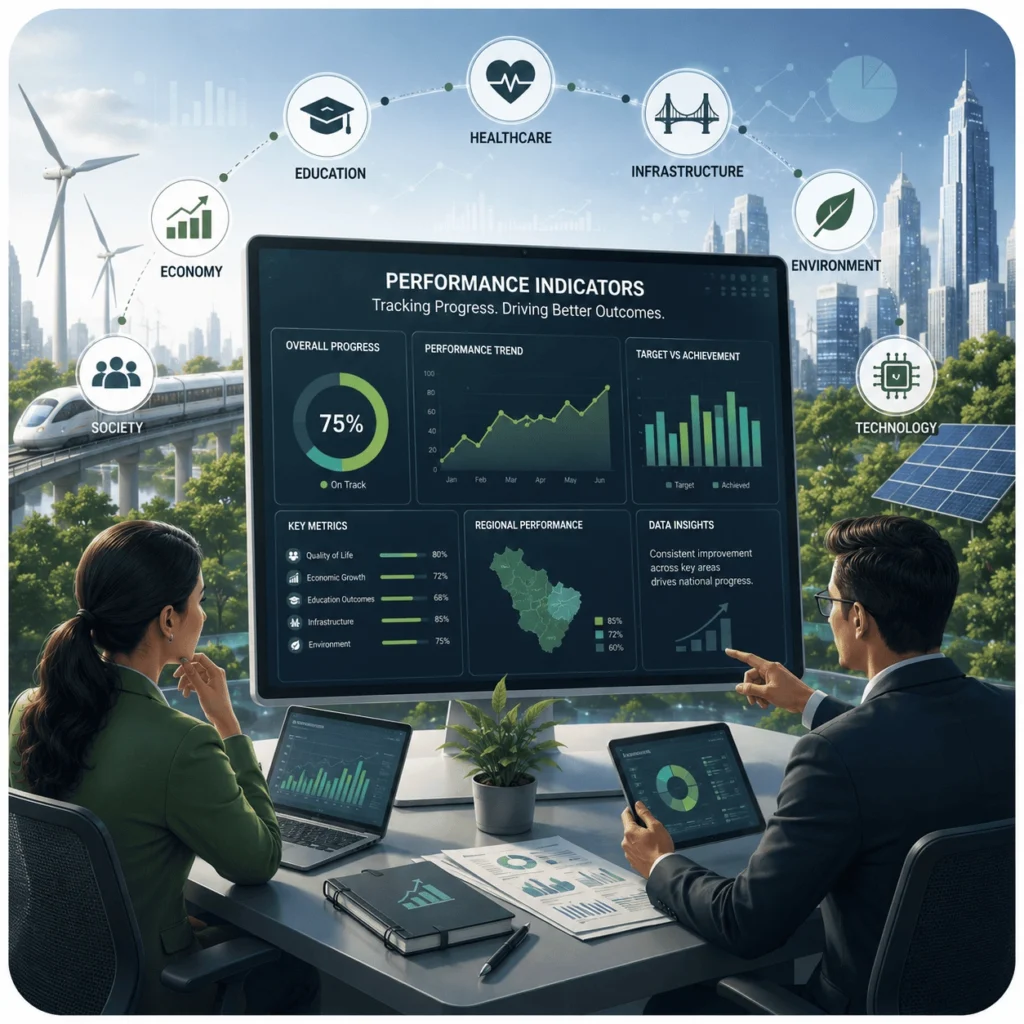
Performance indicators provide more than data points and statistics. They help create a clearer understanding of how societies evolve, how economies grow, and how institutions improve over time.
By measuring outcomes across critical areas of development, organizations gain the insights needed to make informed decisions, allocate resources effectively, and pursue long-term goals with greater confidence. Performance measurement helps transform ambition into action and action into measurable results.
As the UAE continues to advance across multiple sectors, the ability to evaluate progress consistently will remain an important part of building stronger communities, competitive economies, sustainable environments, and greater opportunities for future generations.