Dubai Economic Agenda D33 Explained: Priority Sectors, Targets and Business Opportunities
Share this post
Last reviewed: July 2026. Checked quarterly against Dubai Media Office and Digital Dubai economic releases.
Most explainers of the Dubai Economic Agenda D33 repeat the same headline, double the economy by 2033, and stop there. That leaves out the part that actually matters if you are a founder, investor or job seeker: which sectors D33 is actually pushing capital toward, what the measurable targets are behind the headline, and how you track whether Dubai is actually on pace. This guide translates D33 from a government strategy document into what it means for a real business decision today.
What Is the Dubai Economic Agenda D33?
- Launched in 2023 by His Highness Sheikh Mohammed bin Rashid Al Maktoum, Vice President and Ruler of Dubai
- A 10-year strategic plan running to 2033, timed to align with the 200th anniversary of Dubai’s founding
- Built around 100 transformational projects spanning trade, industry, digital transformation and talent development
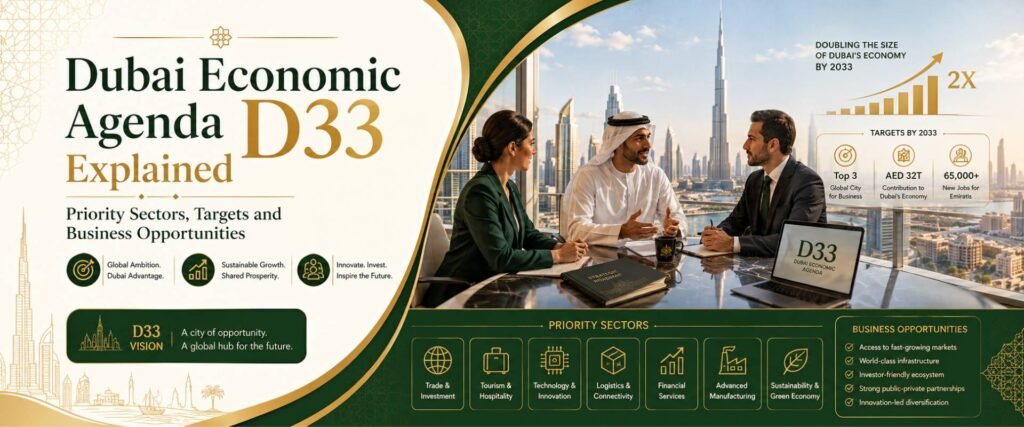
- The core ambition: double the size of Dubai’s economy and position the city among the world’s top three cities for living, working and investing
- Administered and tracked through the Department of Economy and Tourism (DET) and Digital Dubai’s statistical infrastructure
D33 sits within a longer arc of Dubai economic planning, following on from earlier growth strategies, and it is explicitly framed as the next chapter of the same competitive knowledge economy ambitions that have shaped Dubai’s development for over a decade.
The Core Economic Targets in Plain Language
D33’s headline target is doubling Dubai’s economy to a cumulative AED 32 trillion in economic activity over the decade. Underneath that headline sit specific, measurable targets, sourced directly from the official D33 platform:
| Target area | Past decade | Next decade goal |
|---|---|---|
| Foreign trade (goods and services) | AED 14.2 trillion | AED 25.6 trillion |
| Foreign direct investment, annual average | AED 32 billion | AED 60 billion |
| Foreign direct investment, cumulative | n/a | AED 650 billion by 2033 |
| Government expenditure | AED 512 billion | AED 700 billion |
| Private sector investment | AED 790 billion | AED 1 trillion |
| Domestic demand for goods and services | AED 2.2 trillion | AED 3 trillion |
| Digital transformation, annual contribution | n/a | AED 100 billion |
Additional stated goals include integrating 65,000 young Emiratis into private-sector employment in high-growth fields, expanding Dubai’s foreign trade map by roughly 400 additional cities, and growing annual tourism to 25 million visitors by 2033.
Priority Sectors and Emerging Opportunity Areas
D33 does not spread investment evenly across the economy. It concentrates on a defined set of high-growth priority sectors:
- Technology and artificial intelligence, spanning AI infrastructure, applied AI across government and private sectors, and the broader digital economy
- Financial services and fintech, building on the DIFC’s role as a regional financial hub
- Advanced manufacturing and industrial value-add, targeting greater self-sufficiency in key manufacturing categories
- Logistics and global trade, leveraging Jebel Ali Port and Al Maktoum International Airport as connectivity anchors
- Green technology and sustainability, aligned with the UAE’s broader net-zero commitments
- Tourism and hospitality, targeting Dubai’s position as a top-three global tourism and business destination
This sector concentration is the single most useful filter for founders deciding where to position a new business, since D33-aligned sectors typically see faster licensing support, more active free zone incentives, and stronger government-backed demand.
What D33 Means for Startups and Foreign Investors
Structural Changes That Favour New Entrants
- Simplified licensing is a consistent theme across D33-aligned reforms, including the Dubai Unified License initiative that reduces duplication for companies operating across multiple jurisdictions within the emirate
- 100% foreign ownership, now standard across most mainland activities and all free zones, directly supports D33’s foreign investment targets by removing a historical barrier for international founders
- SME growth is explicitly named as a strategic priority, not an incidental beneficiary, reflected in continued investment in accelerator and incubator infrastructure
Where the Capital Is Actually Flowing
- Public-private partnership structures have expanded specifically around D33-priority sectors, giving founders in those categories more direct access to institutional funding conversations
- Venture capital activity has grown fastest in AI, fintech and logistics technology, mirroring D33’s own sector priorities rather than moving independently of them
- Government procurement and tender activity increasingly favours companies aligned with D33’s digital transformation and advanced manufacturing goals
If you are evaluating where to base a new company, our guides on how foreign investors can open a business in Dubai and the best free zones in Dubai for startups cover the practical setup steps that sit underneath these D33-level ambitions, and our guide to UAE corporate tax for small businesses covers how the tax environment interacts with this growth strategy.
Trade, Logistics, Tourism and Digital-Economy Implications
- Trade expansion is targeted through both volume growth, the AED 25.6 trillion foreign trade goal, and market diversification, with roughly 400 new cities added to Dubai’s active trade network
- Logistics investment continues around Jebel Ali Port, one of the world’s busiest container ports, and Al Maktoum International Airport’s ongoing decades-long expansion
- Tourism targets of 25 million annual visitors by 2033 are supported by expanding hotel capacity, an aggressive events calendar, and continued visa facilitation for international visitors
- The digital economy’s AED 100 billion annual target reflects Dubai’s ambition to generate genuinely new economic value from AI, e-commerce and digital services, not simply digitise existing activity
Skills and Talent Priorities
- D33 explicitly targets integrating 65,000 young UAE nationals into private-sector roles across high-growth sectors, tying Emiratisation policy directly to economic strategy rather than treating it as a separate compliance requirement
- Skills demand under D33 concentrates heavily in AI, data, fintech and advanced manufacturing, areas where our guide to the most in-demand skills in the UAE job market tracks current hiring trends in detail
- Dubai’s broader ambition to remain a magnet for skilled international talent runs alongside the Emiratisation push, rather than in competition with it, reflected in continued Golden Visa expansion for skilled professionals and specialists
Infrastructure and Quality-of-Life Projects Supporting D33
D33’s economic targets depend on infrastructure investment happening in parallel, not afterward. Supporting projects include continued expansion of Al Maktoum International Airport, ongoing Dubai Metro network growth, and ambitious urban development under Dubai’s long-term master planning. Major business events also play a direct role in this pipeline; our guide to top industry events in the UAE covers the flagship shows, GITEX Global among them, that D33-aligned sectors use as a platform for deal-making and investment introductions.
How to Track D33 Progress Using Official Indicators
D33 is not a set-and-forget announcement; Dubai now publishes regular, dated economic data specifically to track it.
Where the Data Comes From
- Quarterly GDP releases from Digital Dubai and Dubai Media Office report growth against D33 benchmarks; Dubai’s GDP reached AED 232 billion in the first quarter of 2026 alone, a 2.4% year-on-year increase
- The Dubai Economic Survey, launched to strengthen the emirate’s underlying data infrastructure, now collects data from more than 16,000 establishments to produce more accurate GDP, employment and sector-level statistics specifically in support of D33 monitoring
- Check the official D33 page on the UAE government portal and Invest in Dubai’s D33 resource directly for the latest confirmed figures, since quarterly updates can shift the picture meaningfully within a single year
What the Numbers Show So Far
- Full-year 2025 figures showed GDP rising from AED 890 billion in 2024 to AED 972 billion in 2025, with employment growing from 4.48 million to 4.69 million people over the same period
- Sector-level tracking matters as much as headline GDP; health and social work grew 17.5% year-on-year in early 2026, alongside strong gains in construction, finance, real estate and trade
- The non-oil economy now accounts for more than 75% of Dubai’s GDP, evidence that the underlying diversification D33 is built on is already well underway rather than aspirational
- Independent economic commentary through 2025 and into 2026 has generally described Dubai as on track or ahead of its interim D33 targets, though official confirmation of full-decade progress will only be possible as more of the ten-year window plays out
Frequently Asked Questions
What is the main goal of the Dubai Economic Agenda D33?
To double the size of Dubai’s economy to a cumulative AED 32 trillion by 2033 and position Dubai among the world’s top three cities for living, working and investing.
What are the priority sectors under D33?
Technology and AI, financial services and fintech, advanced manufacturing, logistics and trade, green technology, and tourism are the most consistently cited priority sectors.
How does D33 affect foreign investors specifically?
D33 targets increasing annual foreign direct investment from AED 32 billion to AED 60 billion, supported by 100% foreign ownership rules, simplified licensing, and continued free zone expansion.
Is Dubai on track to meet its D33 targets?
Recent GDP and employment data through 2025 and early 2026 show consistent growth aligned with D33 benchmarks, with independent commentary generally describing Dubai as on or ahead of pace, though full confirmation depends on tracking the entire decade.
How many projects fall under the D33 agenda?
D33 encompasses 100 transformational projects spanning trade, industry, digital transformation, talent development and infrastructure.
Where can I check official D33 progress data?
Through Digital Dubai’s quarterly GDP releases, the Dubai Economic Survey, and the official D33 pages on the UAE government portal and Invest in Dubai’s website.