Last reviewed: July 2026. Checked quarterly against DET, MOIAT and Dubai Municipality published requirements.
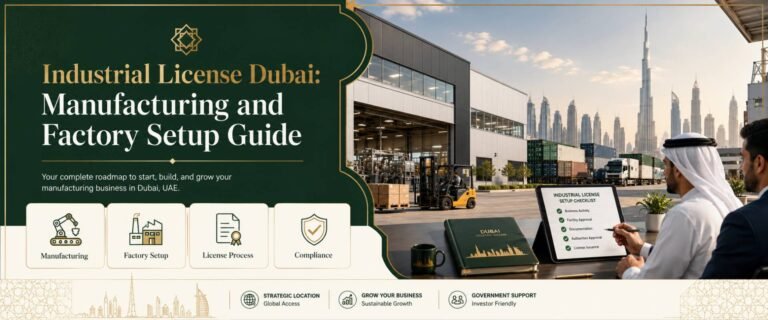
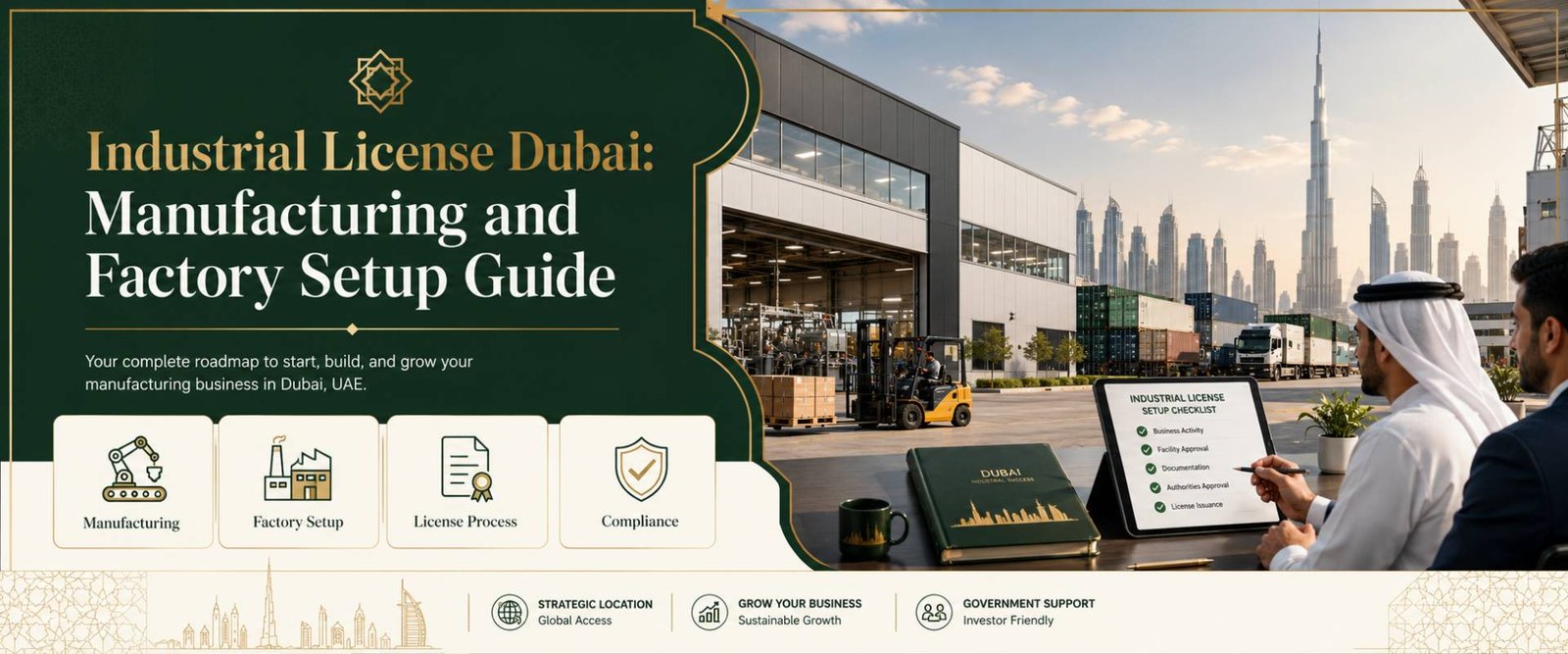
Most industrial license guides for Dubai just repeat generic trading-license content with the word “manufacturing” swapped in. That misses the entire point of this license category: an industrial license triggers a distinct set of mandatory approvals, Civil Defence, environmental clearance, utility capacity, and federal industrial registration, that a trading or professional license never touches. This guide isolates exactly what makes industrial licensing different, what it costs, and where to set up a factory or production facility in Dubai, whether you are scaling an existing production line or establishing your first manufacturing footprint in the UAE.
What Is an Industrial License and Who Needs One?
An industrial license authorises a company to manufacture, process, or assemble raw materials and components into new physical products within a designated industrial zone. It is issued by Dubai’s Department of Economy and Tourism (DET) for mainland operations, or by an industrial free zone authority for free zone setups.
- Who needs one: any business physically transforming materials, food production, textiles, metal fabrication, furniture manufacturing, printing and packaging, chemical processing, equipment assembly, and building materials manufacturing all fall under this category
- Who does not: a business that imports finished goods and resells them needs a commercial license, not an industrial one, since no physical transformation is taking place
- Physical facility is mandatory: unlike a commercial or professional license, an industrial license cannot be issued against a flexi-desk or standard office; applicants must secure a warehouse, factory, or industrial plot inside an approved industrial zone before final approval
- The activity classification determines everything downstream: your chosen industrial activity code decides which external approvals apply, what inspection cadence you face, and what fee structure your license falls under, so selecting the precise activity, rather than the closest-sounding one, is worth getting right at the application stage rather than amending later
- Manufacturing is a named priority sector under the UAE’s broader Dubai Economic Agenda D33, which is part of why industrial licensing has become a more actively promoted setup category in recent years, not just a compliance category
Industrial vs Commercial vs Professional License
Dubai issues three core license categories, and choosing the wrong one either restricts your legal activity or forces an unnecessary compliance burden.
| Feature | Industrial License | Commercial License | Professional License |
|---|---|---|---|
| Core activity | Manufacturing, processing, assembly | Trading physical goods | Specialised services or expertise |
| Facility requirement | Factory or industrial plot, mandatory | Office or showroom | Office, often visa-quota linked |
| Key compliance focus | Worker safety, machinery, environmental standards | Supply chain, product standards | Professional qualifications, contracts |
| Typical external approvals | MOIAT, Municipality, Civil Defence, DEWA | Activity-dependent, often minimal | Usually minimal |
| Example activities | Food production, metal fabrication, chemical manufacturing | General trading, retail, e-commerce | Consultancy, IT services, legal advice |
The decision test is simple: if your revenue comes from selling a physical item you sourced from someone else, you need a commercial license, covered in our guide to the general trading license in Dubai. If your revenue comes from selling something you physically made or transformed, you need an industrial license instead.
Approvals Required: Civil Defence, Environment and Municipality
This is the section that genuinely separates industrial licensing from every other category, and it is where most generic guides fall short. Four approvals are mandatory for essentially every industrial license application, run in parallel rather than sequentially wherever possible:
The Four Core Approvals
- MOIAT (Ministry of Industry and Advanced Technology): federal industrial compliance registration and, after the local license is issued, the Industrial Production Certificate, which unlocks customs duty exemptions on imported machinery and raw materials
- Dubai Municipality: environmental clearance, health and hygiene compliance, land use approval, and a waste management assessment specific to your production process
- Dubai Civil Defence: fire safety inspection and emergency readiness certification of the actual production facility, not just the office
- Dubai Electricity and Water Authority (DEWA): confirmation that utility capacity, electricity and water, can actually support your planned production volume
Sector-Specific Additional Approvals
- Food, cosmetics or pharmaceutical manufacturing: Ministry of Health and Prevention (MOHAP) approval, plus a food safety certificate and HACCP compliance for perishable production
- Chemical or hazardous material processing: Ministry of Interior clearance, given the security and safety implications of handling controlled substances
- Larger-scale operations: a full environmental impact assessment, industrial waste management plan, and air and noise compliance testing from the Ministry of Climate Change and Environment
Coordinating these approvals in parallel rather than waiting for each one sequentially is the single biggest lever for cutting weeks off your total setup timeline, since MOIAT, Municipality, Civil Defence and DEWA each run independent review processes that do not depend on one another’s outcome.
Step-by-Step: Applying for an Industrial License
- Select your precise industrial activity from the DET or free zone authority’s activity list, confirming it matches your actual production process rather than the closest available category
- Choose your jurisdiction, mainland for unrestricted UAE market access, or a specific industrial free zone for cost efficiency and sector-specific infrastructure
- Obtain initial approval, submitting a business plan, financial projections, and a preliminary facility layout for DET or free zone review
- Secure your industrial premises, a warehouse, factory, or industrial plot located within an approved industrial zone, since this must be confirmed before final approval is possible
- Prepare your technical documentation, including detailed factory blueprints, manufacturing process flow, machinery specifications, and quality control procedures
- Submit external approval applications in parallel: Dubai Municipality, Dubai Civil Defence, DEWA, and MOIAT, plus any sector-specific approvals your activity triggers
- Submit the complete application to DET or your free zone authority once all approvals and technical documentation are in hand
- Receive your industrial license, then apply separately for the MOIAT Industrial Production Certificate to unlock customs duty exemptions on imported machinery and raw materials
- Complete post-license steps: staff visas under your establishment card, corporate bank account, and VAT and corporate tax registration with the FTA
Best Industrial Free Zones and Mainland Zones for Manufacturing
Jebel Ali Free Zone (JAFZA)
- One of the most cost-competitive options for manufacturers, with a single manufacturing facility license covering up to seven activities priced at roughly AED 5,000 a year
- Direct port access through Jebel Ali Port, one of the world’s busiest container ports, a genuine logistics advantage for manufacturers exporting finished goods or importing raw materials at scale
- Well suited to established manufacturers prioritising shipping efficiency and export volume over proximity to Dubai’s city centre
- A long operating history as an industrial free zone means banks, logistics providers and insurers are generally well versed in JAFZA-based manufacturing clients, which can smooth banking and insurance approval compared with newer or smaller zones
Dubai Industrial City (DIC)
- A purpose-built industrial free zone with dedicated manufacturing infrastructure, packages starting from around AED 28,000
- Home to more than 800 customers and 300 operational factories, giving it genuine manufacturing-cluster density and supplier proximity, useful for businesses that benefit from being near complementary manufacturers and suppliers
- Suited to manufacturers who want to be inside an established industrial ecosystem with dedicated zoning for food, chemicals, base metals and equipment manufacturing, rather than a standalone facility elsewhere
Dubai South
- Positioned near Al Maktoum International Airport and the wider logistics corridor, with packages starting from around AED 25,000
- A strong fit for manufacturers whose supply chain leans on air freight or who plan to co-locate near Dubai’s expanding logistics infrastructure
Mainland (DET)
- Government license fees typically range from AED 14,000 to 30,000, varying by specific activity and legal structure
- The clear advantage is unrestricted access to the UAE mainland market, direct sales to local retailers, distributors and government buyers without the restrictions free zone companies can face
- Best suited to manufacturers whose primary customer base is inside the UAE itself, rather than export-focused
Cost and Timeline for an Industrial License
Industrial setup costs run meaningfully higher than commercial or professional licenses, driven by facility, machinery and multi-authority compliance requirements rather than the base license fee alone.
| Cost component | Typical range (AED) |
|---|---|
| Mainland (DET) license fee | 14,000 to 30,000 |
| JAFZA manufacturing facility license | From 5,000 per year |
| Dubai Industrial City package | From 28,000 |
| Dubai South package | From 25,000 |
| Establishment card | 2,000 per card |
| External approval fees (Civil Defence, DEWA, Municipality) | Activity-dependent, additional |
These figures cover government and licensing fees only. They do not include facility lease costs, factory fit-out, machinery, or ongoing compliance costs, which typically represent the larger share of total setup spend for any genuine manufacturing operation. For the broader cost planning context across licence types, our guide to the general trading license Dubai piece covers a useful cost comparison if you are still deciding between an industrial and a commercial structure.
Realistic timeline: initial DET or free zone approval typically takes one to two weeks once your business plan and facility layout are submitted. The external approval stage, MOIAT, Municipality, Civil Defence and DEWA combined, commonly adds three to six weeks depending on activity complexity and whether sector-specific approvals apply. Budget six to ten weeks end to end for a straightforward manufacturing activity, longer for food, chemical or hazardous-material processing given the additional regulatory layers involved.
How D33 Is Shaping UAE Manufacturing Incentives
Manufacturing sits at the centre of the UAE’s federal industrial strategy, and Dubai’s own economic planning reflects that priority directly.
- Operation 300bn, led by MOIAT, is the UAE’s flagship 10-year industrial strategy, aiming to raise the industrial sector’s GDP contribution from AED 133 billion to AED 300 billion by 2031
- The strategy specifically targets support for 13,500 industrial SMEs, roughly matching the fact that SMEs already make up 95% of the UAE’s more than 33,000 industrial enterprises
- Research and development spending in the industrial sector is targeted to nearly triple, from AED 21 billion to AED 57 billion by 2031
- The strategy includes 100% foreign ownership for industrial projects and dedicated financing support, with the Emirates Development Bank acting as a key enabler for manufacturers seeking capital
- The “Make it in the Emirates” campaign, launched alongside Operation 300bn, promotes a unified “Made in UAE” brand identity, part of a deliberate push to build export credibility for UAE-manufactured goods
- The National In-Country Value (ICV) programme, a companion initiative, redirected roughly AED 53 billion into the domestic economy in a single recent year, a 25% increase year on year, by weighting government and semi-government procurement toward suppliers with genuine local manufacturing content
- MOIAT issued 263 new industrial production licenses in a single recent year alone, a 20% increase year on year, a concrete signal that new manufacturing entrants are actually taking up these incentives rather than the programme remaining aspirational
- This national industrial push directly complements Dubai’s own Economic Agenda D33, which names advanced manufacturing among its priority sectors, and it sits within the UAE’s broader competitive knowledge economy and sustainable environment and infrastructure ambitions, since much of the incentive structure specifically favours clean energy adoption and circular-economy manufacturing practices
For manufacturers evaluating whether now is the right time to establish a Dubai production facility, this is a genuinely favourable policy backdrop, government financing support, customs duty exemptions on machinery through the MOIAT Industrial Production Certificate, and a national campaign actively promoting UAE-made goods, rather than simply a regulatory box to check. For structuring support specific to mainland industrial setup, firms such as DIAC’s mainland company formation service work through the practical sequencing of DET licensing alongside the external approvals covered above.
Frequently Asked Questions
What activities require an industrial license in Dubai?
Any business that manufactures, processes, or assembles raw materials or components into new physical products, including food production, textiles, metal fabrication, chemical processing, and equipment assembly.
How much does an industrial license cost in Dubai?
Mainland licenses through DET typically cost AED 14,000 to 30,000 in government fees. Free zone options vary widely, from around AED 5,000 a year at JAFZA to AED 25,000 or more at Dubai Industrial City or Dubai South, excluding facility and approval costs.
What approvals are required for an industrial license?
Four approvals are mandatory for most industrial activities: MOIAT for federal industrial compliance, Dubai Municipality for environmental and health clearance, Dubai Civil Defence for fire safety, and DEWA for utility capacity confirmation.
Can a free zone industrial company sell to the UAE mainland?
Generally only through a licensed distributor or a mainland permit obtained under recent free zone reform, similar to the restrictions that apply to free zone trading companies more broadly.
How long does it take to get an industrial license in Dubai?
Realistically six to ten weeks end to end for a straightforward manufacturing activity, accounting for initial approval and the parallel external approval process, longer for food, chemical or hazardous-material activities.
Does Dubai offer incentives for manufacturing businesses?
Yes. Under Operation 300bn and Dubai’s own economic strategy, manufacturers can access 100% foreign ownership, customs duty exemptions on machinery and raw materials through MOIAT’s Industrial Production Certificate, and dedicated financing support through the Emirates Development Bank.