Last reviewed: July 2026. Checked annually, or whenever a major national vision announcement is made, against official UAE government sources.
Search “UAE Vision 2030” and you will get results for at least two genuinely different national plans, sometimes on the same page, without anyone flagging the confusion. This guide resolves it directly: what “UAE Vision 2030” actually refers to, how it differs from the federal “We the UAE 2031” strategy, and how both connect back to Vision 2021, the plan this very platform takes its name from.
Why “UAE Vision 2030” Actually Means Two Different Things
- Abu Dhabi Economic Vision 2030 is an emirate-level economic plan, specific to Abu Dhabi alone, launched in 2006 and published as a formal policy agenda in 2007
- “UAE Vision 2030” is also commonly used, inaccurately, as informal shorthand for the federal We the UAE 2031 strategy, the nationwide plan that actually succeeded UAE Vision 2021 in 2022
- These are not the same document, do not share a launch date, and do not share a governing authority, one is Abu Dhabi’s emirate-level economic roadmap, the other is a federal, whole-of-UAE national strategy
- The confusion is compounded because both plans set a comparable 2030-to-2031 horizon and both talk about economic diversification, but they operate at entirely different levels of government
| Abu Dhabi Economic Vision 2030 | We the UAE 2031 | |
|---|---|---|
| Scope | Emirate-level, Abu Dhabi only | Federal, entire UAE |
| Launched | 2006, policy agenda published 2007 | 22 November 2022 |
| Governing body | Government of Abu Dhabi | UAE federal government |
| Core focus | Reducing oil dependency in Abu Dhabi’s economy | Doubling national GDP, social and diplomatic development |
| Target year | 2030 | 2031 |
If you searched “UAE Vision 2030” expecting one single document, the honest answer is that the specific plan you want depends on whether your interest is Abu Dhabi’s emirate-level economy or the UAE’s federal national strategy. Both are covered in full below.
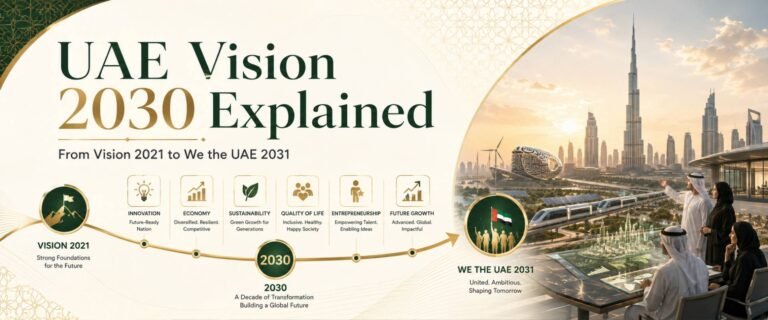
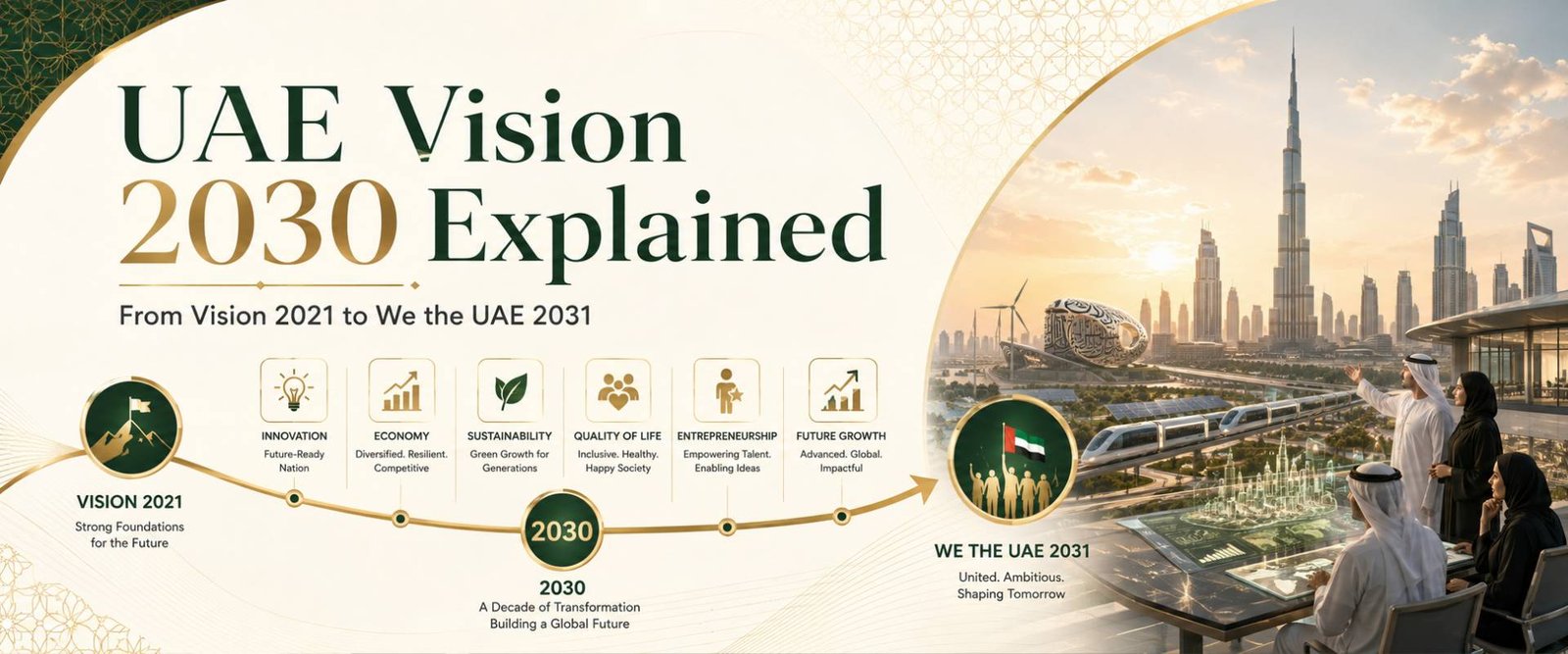
From Vision 2021 to We the UAE 2031: What Changed
UAE Vision 2021, launched in 2010 by His Highness Sheikh Mohammed bin Rashid Al Maktoum, Vice President and Prime Minister of the UAE and Ruler of Dubai, was the federal government’s long-term plan to position the UAE among the best countries in the world by 2021, the Golden Jubilee of the UAE’s formation as a federation. Full documentation of the original plan remains available through the UAE Cabinet’s official National Agenda archive.
Vision 2021’s Structure
- Built on four overarching pillars: United in Responsibility, United in Destiny, United in Knowledge, and United in Prosperity
- Delivered through a seven-year National Agenda, launched in 2014, organised around six national priorities: cohesive society and preserved identity, safe public and fair judiciary, competitive knowledge economy, first-rate education system, world-class healthcare, and sustainable environment and infrastructure
- Tracked through 52 National Key Performance Indicators (NKPIs) benchmarked against global standards
This structure is the direct ancestor of the priority areas referenced throughout this platform, and it is why a site built on the Vision 2021 name still organises its own content around these same national priorities today.
The Transition to We the UAE 2031
- Vision 2021 formally concluded in its target year, having achieved its Golden Jubilee positioning goals
- We the UAE 2031 was launched on 22 November 2022 during the UAE Government Annual Meetings, explicitly framed as the next ten-year federal strategy following Vision 2021’s completion
- Where Vision 2021 was framed around unity and consolidation, “United in Responsibility,” “United in Knowledge,” and so on, We the UAE 2031 is framed around economic scale and forward momentum, doubling GDP, expanding trade, and building global competitiveness rather than internal cohesion alone
- The naming shift itself is deliberate: Vision 2021 spoke of what the UAE would become by a fixed date; We the UAE 2031 speaks in the collective present tense, positioning the strategy as a shared national identity project as much as an economic plan
- Both plans sit inside the UAE’s longer-range 50-year horizon set by UAE Centennial 2071, launched in 2017, which aims to make the UAE the best country in the world by the time it marks a full century since its founding
- All government entities, federal and local, along with the private sector, are expected to align delivery against We the UAE 2031’s ten-year framework, mirroring how Vision 2021’s National Agenda cascaded down through federal ministries and individual emirates a decade earlier
Abu Dhabi Economic Vision 2030: The Emirate-Level Plan
Abu Dhabi Economic Vision 2030 predates We the UAE 2031 by more than a decade and operates at a different level of government entirely.
- Launched by the Government of Abu Dhabi in 2006, with the formal policy agenda published in 2007
- Focused specifically on economic diversification away from oil dependency within the Emirate of Abu Dhabi
- Organised around nine pillars, including a large, empowered private sector, a sustainable knowledge-based economy, a transparent and streamlined regulatory environment, optimised resource utilisation, strong international relationships, and premium education and healthcare infrastructure
- Core numeric target: shifting Abu Dhabi’s non-oil GDP contribution from roughly 52% in 2020 toward 64% by 2030, alongside phased milestones set for 2020, 2025 and 2030 to let the Emirate track and adjust progress along the way
- Priority sectors under the plan include manufacturing, financial services, tourism, media, healthcare, education, renewable energy and technology, with tourism specifically targeted to contribute 10% of Abu Dhabi’s GDP and add an estimated 178,000 jobs by 2030
- Now tracked under an updated framework sometimes referred to as Abu Dhabi Economic Vision 2030+, alongside the Emirate’s Annual Development Planning Cycle
Confirm current progress directly through the official Abu Dhabi Economic Vision 2030 page on the UAE government portal, since this plan is tracked separately from federal-level reporting on We the UAE 2031.
The Four Pillars of We the UAE 2031
We the UAE 2031 is structured around four pillars, each covering a distinct dimension of national development:
- Forward Society: strengthening citizen wellbeing, education, healthcare and social cohesion, with an ambition to place the UAE among the top ten countries on the Human Development Index
- Forward Economy: doubling GDP, expanding non-oil trade and exports, and accelerating growth in future-facing sectors such as artificial intelligence, fintech, advanced manufacturing and space technology
- Forward Diplomacy: strengthening the UAE’s global standing and international partnerships, grounded in humanitarian values and expanded diplomatic reach
- Forward Ecosystem: modernising government performance, digital infrastructure, and regulatory agility, with ambitions around cybersecurity, food security, and global governance rankings
Unlike Abu Dhabi Economic Vision 2030’s single-emirate scope, these four pillars apply across the entire UAE federation, coordinated through federal ministries and cascaded down to emirate-level implementation, including Dubai’s own economic strategy.
Measurable Targets: Doubling GDP to AED 3 Trillion
We the UAE 2031’s headline target is genuinely simple to state, doubling the UAE’s GDP, but the underlying benchmarks are specific and trackable:
| Target area | Baseline | 2031 Goal |
|---|---|---|
| National GDP | AED 1.49 trillion (2022) | AED 3 trillion |
| Non-oil exports | Not specified in official baseline | AED 800 billion |
| Tourism GDP contribution | Not specified in official baseline | AED 450 billion |
| Foreign trade | Not specified in official baseline | AED 4 trillion |
| Foreign direct investment | Not specified in official baseline | AED 550 billion cumulative |
| Digital economy GDP contribution | 9.7% | 19.4% |
| Non-oil GDP contribution | Below target | 70% |
As of November 2025, the UAE’s Minister of Cabinet Affairs, Mohammad Al Gergawi, publicly confirmed that 67% of the targets set under We the UAE 2031 had already been achieved, a genuinely notable interim progress marker roughly halfway through the plan’s ten-year horizon. High-growth sectors including technology, financial services, advanced manufacturing, renewable energy and healthcare are cited as the primary engines behind this progress, supported by continued foreign direct investment and targeted industrial policy initiatives such as Operation 300bn, the UAE’s separate industrial strategy aimed at raising the manufacturing sector’s GDP contribution from under 9% toward 25% by 2031. As of Q2 2025, manufacturing was already the largest non-oil contributor to GDP, a sign that the industrial pillar of this broader ambition is translating into measurable output rather than remaining a stated intention.
How These Visions Connect to D33 and Everyday Policy
National-level strategy rarely stays abstract in the UAE; it cascades directly into emirate-level and sector-level policy that businesses and residents interact with day to day.
- Dubai’s own economic strategy, the Dubai Economic Agenda D33, operates as Dubai’s emirate-level contribution to the same national growth ambitions embedded in We the UAE 2031, targeting a doubling of Dubai’s own economy to AED 32 trillion in cumulative activity by 2033
- Just as Abu Dhabi Economic Vision 2030 diversifies Abu Dhabi’s economy away from oil at the emirate level, D33 diversifies Dubai’s economy toward technology, trade, tourism and financial services, both feeding into the same federal non-oil GDP and foreign trade targets set under We the UAE 2031
- This is the pattern worth understanding: the federal vision sets the destination, and each emirate builds its own economic agenda to get there on its own terms, rather than a single top-down plan being imposed uniformly across Abu Dhabi, Dubai and the Northern Emirates
- Federal-level policy shifts, corporate tax implementation, foreign ownership reform, Golden Visa expansion, and Emiratisation programmes, all trace back to the Forward Economy and Forward Society pillars of We the UAE 2031 rather than existing as isolated regulatory changes
- Understanding this layered structure, federal vision, emirate-level economic agenda, sector-specific policy, is genuinely useful for founders and investors, since it explains why UAE business reforms tend to arrive in coordinated waves rather than as one-off announcements, and why a policy change in one emirate often signals a similar change coming elsewhere in the federation
This platform’s own foundation traces back to Vision 2021’s original national priorities, and this article exists specifically to keep that lineage current as the federal strategy has evolved into We the UAE 2031. For the full architecture of national priorities this platform was originally built around, our National Agenda 2021 hub and Our Vision hub remain the reference points for the original six priorities and four founding pillars covered above.
Frequently Asked Questions
Is UAE Vision 2030 the same as We the UAE 2031?
Not officially. “UAE Vision 2030” is often used informally to refer to We the UAE 2031, the actual federal strategy, but it is sometimes confused with the separate, older, emirate-level Abu Dhabi Economic Vision 2030. Always confirm which specific plan a source is referencing.
What replaced UAE Vision 2021?
We the UAE 2031, launched on 22 November 2022, formally succeeded Vision 2021 as the UAE’s federal ten-year national strategy following Vision 2021’s 2021 completion.
What are the four pillars of We the UAE 2031?
Forward Society, Forward Economy, Forward Diplomacy, and Forward Ecosystem, covering social development, economic growth, international relations, and government and digital infrastructure respectively.
Is Abu Dhabi Economic Vision 2030 still active?
Yes, tracked under an updated framework often referred to as Abu Dhabi Economic Vision 2030+, alongside the Emirate’s Annual Development Planning Cycle, continuing its original goal of reducing oil dependency in Abu Dhabi’s economy.
What is the main economic target of We the UAE 2031?
Doubling the UAE’s national GDP from AED 1.49 trillion in 2022 to AED 3 trillion by 2031, alongside targets for non-oil exports, tourism contribution, foreign trade and foreign direct investment.
How does Dubai’s D33 agenda relate to We the UAE 2031?
D33 functions as Dubai’s emirate-level economic strategy, aiming to double Dubai’s own economy, and its targets directly feed into the broader non-oil GDP and foreign trade goals set at the federal level under We the UAE 2031.