Last reviewed: July 2026. Checked monthly against DET and free zone renewal fee schedules.
A trade licence renewal sounds like a formality until it is not, until an expired Ejari blocks the application, or a lapsed licence quietly freezes the company bank account. This guide skips the company-formation basics and focuses entirely on the maintenance side: exactly what DET and free zone authorities check before renewing, the real fee range, the fines that accrue after expiry, and the 30-day window that actually prevents all of it.
When a Dubai Trade Licence Must Be Renewed
- Every Dubai trade licence, mainland or free zone, must be renewed annually to remain legally valid
- Renewal is tied to the licence’s own issue date, not the calendar year, so your renewal window is specific to your company
- Start the process at least 30 days before expiry; this is the practical window that keeps you ahead of Ejari checks, third-party approvals, and any outstanding fine clearance
- A licence that lapses does not just stop new activity, it can immediately affect visas, banking, and existing contracts, covered in detail further down
Mainland and Free-Zone Renewal Differences
Mainland (DET) Renewal
- Regulated by the Department of Economy and Tourism (DET), formerly DED
- Requires a valid Ejari-registered tenancy contract as a mandatory prerequisite; DET will reject the renewal application without one
- Your Ejari should have at least one to three months of validity remaining beyond the licence expiry date
- Renewal fees include the government licence fee, Dubai Chamber of Commerce membership, Knowledge and Innovation Dirham charges, and a market fee, commonly around 5% of annual office rent
Free Zone Renewal
- Each free zone authority, DMCC, IFZA, DAFZA, JAFZA, Meydan, DDA and others, runs its own renewal process, fee structure and timeline
- Most free zones do not require Ejari, since they manage facility agreements internally through their own tenancy or flexi-desk system
- Renewal cost and process still vary meaningfully by zone, so confirm your specific authority’s portal and fee schedule rather than assuming mainland rules apply
If you are still deciding between these structures for a new company rather than renewing an existing one, our guide to mainland vs free zone company setup in Dubai covers that separate decision in full.
Licence requirements can also differ for smaller digital and home-based business models. Entrepreneurs operating or considering this route can review this E-Trader licence Dubai guide for the eligibility, cost and application requirements specific to that licence.
Documents and Compliance Checks
- Current trade licence copy, matching company name and activity exactly
- Ejari-attested tenancy contract for mainland renewals, this is the single most common blocker reported by companies going through renewal
- Memorandum of Association (MOA) and passport and Emirates ID copies of all partners and shareholders
- Landlord No Objection Certificate (NOC), where applicable to your tenancy arrangement
- Activity-specific third-party approvals, from authorities such as Dubai Municipality, Dubai Health Authority, KHDA or RTA, depending on your licensed activity
- Confirmation that no outstanding fines or violations are attached to the licence, since unresolved penalties block renewal until cleared
Verify every detail, partner names, activity codes, and office address, matches your current records exactly before submitting, since mismatched information is one of the most common causes of processing delays. This applies equally whichever activity your licence covers, including a general trading licence, where multiple product categories on one licence make document consistency even more important.
Businesses renewing a commercial trading licence can also review this general trading licence in Dubai guide for a closer look at permitted activities, mainland and free zone options, licensing requirements and the documents involved.
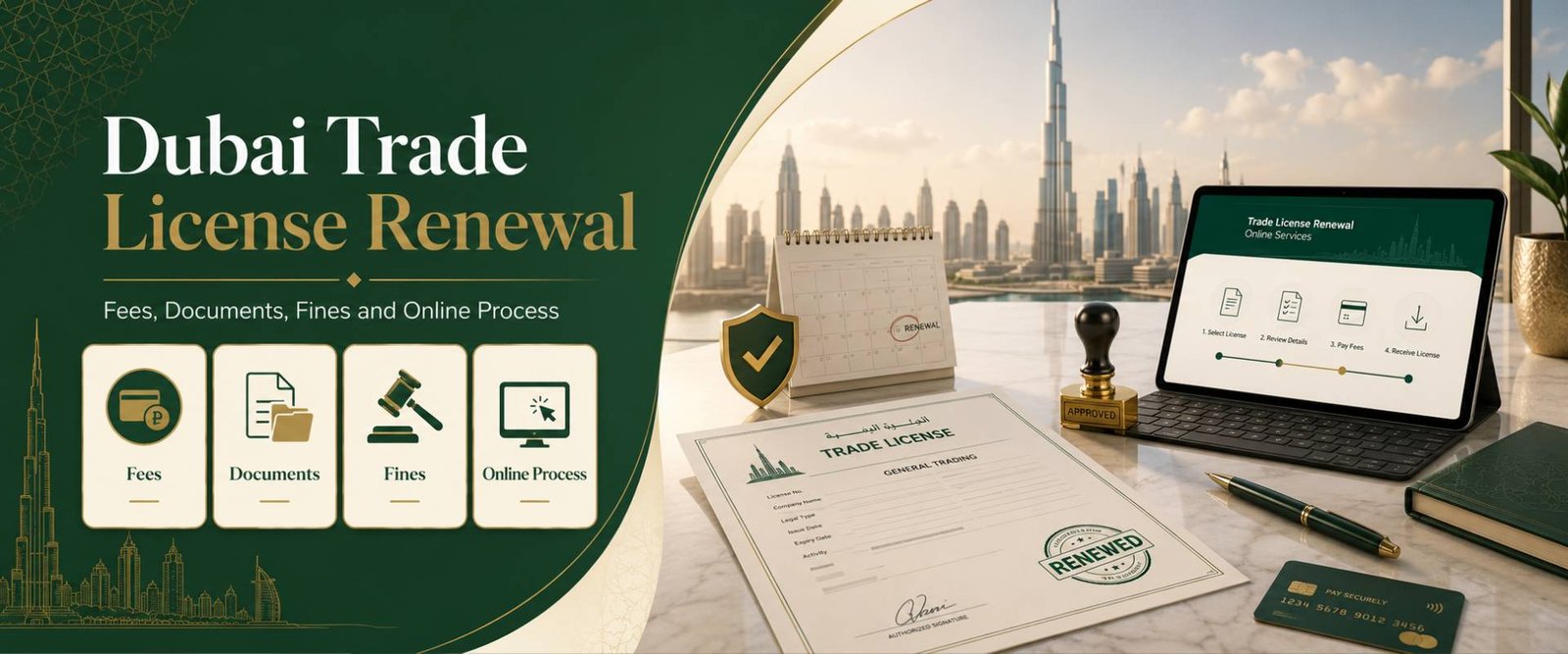
Step-by-Step Online Renewal Process
- Confirm your Ejari or free zone tenancy status is current and valid well before your renewal window opens
- Clear any outstanding fines or violations attached to the licence, since these block renewal until resolved
- Log into the relevant portal: the Invest in Dubai / DET Trader account for mainland companies, or your specific free zone’s own renewal portal
- Enter your licence number and verify company details are accurate
- Upload required documents, including your Ejari certificate, MOA, and any activity-specific approvals
- Pay the renewal fee online by card, or via the Dubai Now app, or by SMS to 6969 for eligible mainland renewals
- Receive your renewed licence, typically within 1 to 2 working days for straightforward renewals, or 3 to 10 working days where external approvals are required
Companies that prefer professional support with licence renewals, government submissions and document clearance can review PRO services in Dubai for assistance with handling these administrative requirements.
Renewal Fees and Cost Variables
| Component | Mainland (DET) | Free zone |
|---|---|---|
| Base renewal fee | AED 8,000 to 15,000 typical | AED 5,750 to 20,000+ depending on zone |
| Chamber of Commerce membership | Included in mainland total | Not applicable |
| Ejari and market fee | Roughly 5% of annual office rent | Not applicable, facility fee instead |
| Establishment card renewal | AED 2,000 to 4,500 additional | Often bundled into package |
| Third-party approval fees | Activity-dependent, added separately | Activity-dependent, added separately |
Total mainland renewal typically lands between AED 8,000 and 15,000, with activity type, office rent, and any required external approvals pushing the figure higher. Free zone renewal costs vary more widely by authority and package tier. For the full first-year cost picture if you are still setting up rather than renewing, our guide to the cost of starting a business in Dubai covers that separately.
Dubai has also introduced renewal-related relief measures during 2026, including a mainland fee adjustment from DET and a broader business incentive package that touched licence-renewal facilitation and short-term fee deferrals. Confirm current relief eligibility directly through DET or Invest in Dubai, since these measures are time-limited and activity-specific rather than blanket reductions.
Late Renewal Fines and Business Consequences
- A grace period of approximately 30 days after expiry is the industry-standard window before escalating penalties apply, though this should always be confirmed against your specific licence type
- Late renewal fines commonly accrue at around AED 250 per month once the grace period passes
- Operating on an administratively closed or suspended licence can trigger a significantly larger penalty, reported at up to AED 10,000 under DET’s compliance framework
- Free zones generally run their own escalating fine structures, some scaling the penalty as a percentage of the renewal fee the longer the licence remains unrenewed
- Penalties continue to accrue until the licence is either renewed or formally cancelled, not simply until you stop trading
How Expiry Affects Visas, Banking and Contracts
An expired trade licence rarely stays contained to the licence itself. The cascade effects are usually what actually forces urgent action:
- Visas: employee and owner visa renewals are blocked while the underlying trade licence is expired, and in extended cases can trigger visa cancellation processes
- Banking: corporate bank accounts can face restricted transactions or a compliance freeze once a bank identifies an expired licence during routine checks; our guide to opening a business bank account in Dubai covers how seriously banks treat licence status generally
- Tax compliance: VAT and corporate tax filing obligations continue regardless of licence status, so an expired licence does not pause your compliance clock; see our guide to UAE corporate tax for small businesses for the filing rules that still apply
- Contracts and tenders: many clients, banks and government tenders require proof of an active licence before engaging, so an expired status can quietly cost you business even before any fine is issued
- Chamber of Commerce membership, tied to your mainland licence, is typically suspended alongside the licence itself
30-Day Renewal Checklist
- Confirm your exact renewal date and count back 30 days as your action deadline
- Renew or verify your Ejari tenancy contract has sufficient remaining validity
- Clear any outstanding fines or compliance violations attached to the licence
- Gather MOA, passport and Emirates ID copies for all partners
- Confirm whether your activity requires any third-party approval renewal, Dubai Municipality, DHA, KHDA or RTA
- Log into the DET or your free zone’s portal and confirm your account details are current
- Budget the full renewal cost, including Chamber membership, Ejari-linked market fee, and establishment card renewal where applicable
- Submit early enough to absorb the 3 to 10 working day timeline if any activity-specific approval is required
If your company was set up through a specific free zone, our guide to the best free zones in Dubai for startups is a useful cross-check if renewal costs or terms have changed enough that switching zones is worth evaluating. Foreign shareholders managing this process from abroad may also find our guide on how foreign investors can open a business in Dubai useful for the wider compliance picture around ownership and visas.
Frequently Asked Questions
How much does it cost to renew a trade licence in Dubai?
Mainland renewal typically costs AED 8,000 to 15,000, including Chamber of Commerce membership and Ejari-linked market fees. Free zone renewal ranges from roughly AED 5,750 to 20,000 or more depending on the authority.
What happens if I do not renew my Dubai trade licence on time?
After the grace period, typically around 30 days, late fines accrue at roughly AED 250 a month, and operating on a suspended or administratively closed licence can trigger a penalty of up to AED 10,000.
Do I need Ejari to renew a free zone licence?
Generally no. Most free zones manage tenancy or flexi-desk arrangements internally and do not require a separate Ejari registration, unlike mainland renewals where it is mandatory.
Can I renew my Dubai trade licence online?
Yes. Mainland renewals go through the DET Trader account on the Invest in Dubai portal, the Dubai Now app, or SMS to 6969. Free zone companies renew through their specific authority’s own portal.
Does an expired trade licence affect my employees’ visas?
Yes. Visa renewals for both employees and owners are typically blocked while the underlying trade licence is expired, and prolonged non-renewal can lead to visa cancellation.
How early should I start my trade licence renewal?
At least 30 days before expiry, to allow time for Ejari verification, clearing any outstanding fines, and processing any activity-specific third-party approvals your business requires.