
Mainland vs Free Zone Company Setup in Dubai: Costs, Visas, Tax and Market Access
Share this post
Last reviewed: July 2026. Checked monthly against DET, free zone authority and Dubai Legislation portal updates.
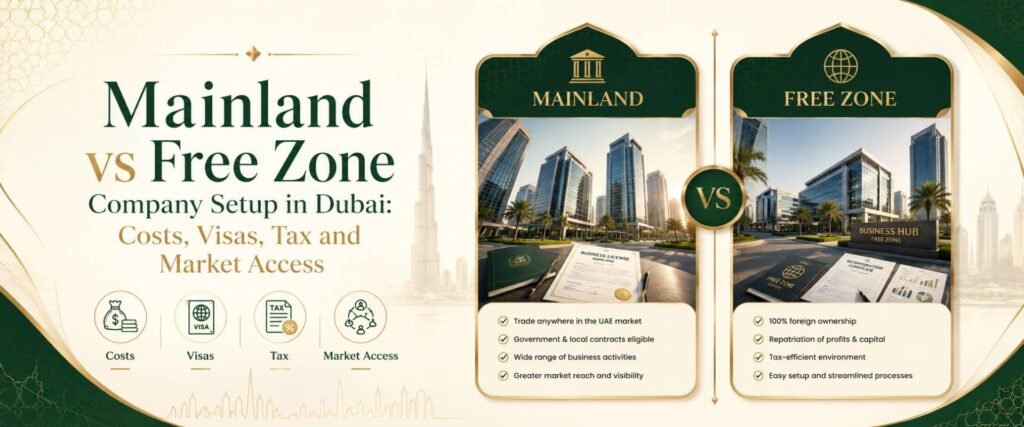
Most mainland vs free zone comparisons still repeat advice that is a few years out of date. The old shorthand, mainland for market access, free zone for 100% ownership, stopped being fully accurate back in 2021, and it changed again in 2025 when Dubai opened a direct licensing path between the two. If you are choosing between a mainland company and a free zone company for your Dubai business setup, this guide covers what actually still differs today: ownership, cost, visas, tax, and the new dual-access route that has quietly reshaped this decision for thousands of founders.
Quick Answer: Which Structure Fits Your Business
- Choose mainland if your customers are inside the UAE, you want to bid on government tenders, or you need an unrestricted, scalable number of visas tied to office size
- Choose free zone if your business is export-facing, digital, or holding-company in nature, and you want the lowest-cost, fastest setup with bundled office and visa packages
- Consider a free zone plus a mainland permit if you want free zone cost and tax treatment but also need to sell directly to mainland UAE clients, now possible without forming a second company
That third option barely existed a few years ago. It is the single biggest reason this decision looks different in 2026 than it did when most mainland vs free zone guides were first written.
Ownership, Licensing Authority and Market Access
A mainland company is licensed by Dubai’s Department of Economy and Tourism (DET) and can trade anywhere in the UAE without restriction. A free zone company is licensed by an individual free zone authority, such as IFZA, DMCC or Meydan, and is historically confined to operating within its own zone, internationally, or with other free zone entities.
Ownership used to be the deciding factor. Since amendments to the UAE Commercial Companies Law in 2021, most mainland business activities now permit 100% foreign ownership without a local Emirati sponsor, closing the gap that once made free zones the automatic choice for foreign founders. Ownership alone is no longer a strong reason to pick one structure over the other; the practical differences now sit in market access, cost structure and tax treatment.
Mainland companies retain one structural advantage that has not changed: they can sell directly to UAE consumers, bid on government contracts, and open physical retail locations across all seven emirates without a distributor. A pure free zone company still cannot do this on its own, which brings us to the most significant regulatory change in this space in years.
Founders who need direct UAE market access can review this detailed Dubai mainland company formation guide for information on licence options, legal structures, registration requirements and the setup process.
The Dual-Licence Route: Free Zone Access to the Mainland
Under Dubai Executive Council Resolution No. 11 of 2025, effective 3 March 2025, most Dubai free zone companies, DIFC-regulated financial institutions are the main exception, can now legally conduct approved activities in mainland Dubai without setting up a separate mainland entity. This closes the gap that used to force free zone businesses into appointing a local distributor or building an entirely second company just to serve mainland clients.
The resolution offers two main routes:
- A branch licence operating out of the free zone: an annual DET fee of AED 10,000, renewable yearly, functioning as an extension of the existing free zone entity rather than a new legal structure
- A temporary permit for specific activities: a one-time fee of AED 5,000, valid for up to six months, suited to short-term or pilot mainland engagements
Both routes require the free zone company’s underlying licence to stay valid, approval from the free zone authority itself, and separate financial record-keeping for mainland versus free zone activity. Companies already conducting unauthorised mainland activity before the resolution were required to regularise their status within one year of the effective date. If your business model depends on selling into the UAE mainland but you would otherwise prefer a free zone’s cost structure, this is now the route to evaluate before defaulting to a full mainland company.
Cost Comparison: Mainland vs Free Zone
| Cost component | Mainland | Free zone |
|---|---|---|
| Licence fee | AED 10,000 to 25,000 | AED 5,800 to 22,000 |
| Office requirement | Mandatory Ejari-registered office | Flexi-desk usually included |
| Establishment card | AED 2,000 | AED 1,000 to 2,000 |
| First investor visa | Around AED 6,500 | AED 3,000 to 5,000 |
| Typical annual renewal | AED 8,000 to 15,000+ | AED 10,000 to 20,000 |
| Mainland access add-on | Included by default | AED 5,000 to 10,000 via Resolution 11 permit |
Free zone packages remain the lower entry cost overall, largely because the office requirement is bundled or waived through a flexi-desk. Mainland’s higher upfront cost is driven almost entirely by the mandatory registered office and market fee, not by the licence fee itself. For a full first-year budget across both structures, including visas and hidden fees, see our detailed cost of starting a business in Dubai guide.
Visa Quotas and Office Requirements
Mainland visa quota scales directly with office size, roughly one visa per 2 square metres for service and professional activities, with no upper limit as your office grows. This makes mainland the more scalable option for a company planning significant headcount growth over several years.
Free zone visa quotas are typically fixed by package: a flexi-desk might support one to three visas, with larger office upgrades needed to unlock more, and most zones cap total visas well below what a large mainland office allows. If you are opening a corporate account as part of this process, our guide on opening a business bank account in Dubai covers the documentation banks expect from each structure.
Tax Treatment: Corporate Tax, VAT and Customs
- Corporate tax: both structures are subject to the UAE’s 0% rate on the first AED 375,000 of taxable income and 9% above that threshold. Free zone companies can additionally qualify as a Qualifying Free Zone Person (QFZP) and retain 0% on qualifying income specifically, provided they meet substance and activity conditions
- Mainland income earned by a free zone company: under Resolution 11, income from mainland activity is generally taxed at the standard 9% rate and must be tracked separately from free zone qualifying income
- VAT: applies identically across both structures once taxable turnover crosses AED 375,000, registered with the Federal Tax Authority
- Customs: free zones, particularly Designated Zones, offer duty suspension on goods held or transiting within the zone, a meaningful advantage for trading and re-export businesses that mainland companies do not share
Large multinational groups should also note the UAE’s Domestic Minimum Top-up Tax, which applies a 15% effective minimum rate to in-scope groups with consolidated global revenue above roughly EUR 750 million, regardless of free zone status. This rarely affects SMEs but is worth flagging if your group has that scale. For a full breakdown of thresholds, reliefs and filing deadlines, our guide to UAE corporate tax for small businesses covers the mechanics in detail.
Which Businesses Should Choose Which Structure
Choose mainland if you are: a retail brand needing a physical storefront, a trading company supplying UAE government or large local clients, a construction or contracting firm bidding on public tenders, or a business planning to scale past 10 to 15 employees within a few years.
Choose a free zone if you are: a consultancy or digital services business serving international clients, an e-commerce brand selling online without a UAE storefront, a holding company managing regional assets, or a startup prioritising the lowest possible entry cost. Our guide to the best free zones in Dubai for startups breaks down which specific zone fits which activity type.
Consider free zone plus a Resolution 11 permit if you are: a free zone-based professional services firm that occasionally needs mainland clients, an e-commerce company that wants to fulfil orders through a mainland distribution partner directly, or any founder who wants to delay the higher-cost mainland decision until mainland revenue justifies it.
If you are a foreign national weighing these options for the first time, our guide on how foreign investors can open a business in Dubai covers the ownership and residency basics that apply regardless of which structure you choose.
For a closer look at licensing, costs, visa options and registration requirements, founders can also review this Dubai free zone company setup guide.
Questions to Ask Before You Decide
- Does my activity actually require unrestricted mainland access, or would a Resolution 11 permit cover it at lower cost?
- How many visas will I realistically need in three years, and does my chosen structure’s office size support that?
- Am I a Qualifying Free Zone Person candidate, and can I maintain the substance requirements that status demands?
- If I import or re-export physical goods, does a Designated Zone’s customs treatment materially change my margins?
- Have I checked the current DET-published list of activities eligible for the free zone mainland permit for my specific business line?
Frequently Asked Questions
Is a free zone company still cheaper than a mainland company in 2026?
Generally yes for entry-level setups, mainly because free zones bundle a flexi-desk instead of requiring a mandatory Ejari-registered office, though the gap has narrowed since mainland ownership reforms.
Can a free zone company now sell directly to mainland customers?
Yes, for most non-financial activities, through a branch licence or temporary permit under Executive Council Resolution No. 11 of 2025, without forming a separate mainland company.
Do free zone companies still get 100% foreign ownership as their main advantage?
Not exclusively. Since the 2021 Commercial Companies Law reform, most mainland activities also allow 100% foreign ownership, so ownership is no longer the deciding factor it once was.
Which structure gives more visas?
Mainland, since visa quota scales with office size with no fixed cap, while free zone quotas are generally fixed by package and require an office upgrade to increase.
Does Resolution 11 of 2025 apply to DIFC companies?
No. DIFC-regulated financial institutions are excluded and continue to operate under DIFC’s own separate legal and regulatory framework.
Is DIFC the same as a regular Dubai free zone for this comparison?
No. DIFC operates under its own common law framework and dispute resolution system, distinct from the DET-regulated mainland and from other Dubai free zones covered by Resolution 11.